18 February 2006

Political action needed to save fishery says expert

Check Mark Hume's piece in the Globe on the need for political action, not more science to save the world's ocean fisheries.

Hume quotes Daniel Pauly, a leading researcher on fisheries issues and director of the Fisheries Centre at the University of British Columbia.
Through analyzing global fishery statistics, he found that the peak happened in parts of the world between the mid-1970s and the mid-1990s. The timing was tied to the spread of industrial fishing.

Once what he calls "peak fish" was reached, the total haul of fish globally began to shrink, despite increased fishing effort and increasingly effective technologies.

...

Dr. Pauly said governments must step in because the fishing industry -- with a primary interest in short-term economic gain, not long-term sustainability of fish stocks -- has not shown any ability to restrain itself.

"The industry is ready to commit suicide at any time. It's an industry that needs to be reined in for its own good."

Dr. Pauly said that illegal catches are common, and he accused most governments of catering to the interests of industry over the needs of citizens.

He said governments need to reduce excess fishing capacity and enforce sustainable fishing levels.

"Public policy must be downsizing the industry to a level that allows for sustained catch and stocks to rebound," he said.
While self-described experts, including people like Gus Etchegary, rail against "foreigners" the reality is that the fishery is in crisis globally and only strong political action that takes a long-term view can work.

Among Pauly's big ideas: stop fishing. That's a bit of an exaggeration, but not much of one.

Check to see how quickly people like Etchegary embrace that radical concept. There are no fish, so stop fishing. Newly appointed federal fish minister Loyola Hearn has already mused publicly about a limited commercial cod fishery on the north-east coast of Newfoundland, a stock which biomass is hovering at as little as 170, 000 metric tonnes.

In the meantime, local politicians continue to push for something called custodial management as the solution to the local problems. Well, as noted here on many occasions, custodial management is an international legal nonsense and, as many suspect, is likely really just cover for increased fish catches by Newfoundland and Labrador interests.

That looks like more of the short-term thinking Pauley criticizes, but to be sure, it reflects the short-term thinking that has gone into most public fisheries policy coming from Newfoundland and Labrador over the past half century.

It's not like other experts - genuine experts - haven't pointed to the problems in the marine ecosystem caused by continued overfishing both domestic and foreign. Ken Frank of the Bedford Institute in Halifax co-authored an article in the journal Science that proposes one possible reason why cod have not recovered in the North Atlantic in the last decade. Frank argues that the changes across five trophic levels in the ocean caused by decimation of a top-level predator, namely cod, have so altered the ecosystem that cod may not recover.

Pit that against the "Evil Spaniards and Demonic Portugese" theory or the "Blame Canada" thesis so common in public comment across Newfoundland and Labrador see which one is intrinsically more convincing.

Voyage of the Damned: Harbour Breton, Danny Williams and the coming fishery crisis

Danny Williams - who this week said he was damned no matter what he did on the Harbour Breton file - can only blame himself and perhaps his own impetuousness for the political backlash he is facing over a deal with Bill Barry to take over a Harbour Breton fish plant.

People have been raising questions about the deal since it was announced. Initially, the concerns on based on Barry's record of acquiring plants in similar circumstances and then shutting the plant town and taking the quota elsewhere. More recently, concern is being expressed since federal fish minister Loyola Hearn said he had approved no quota for Barry and wouldn't do so until he saw a detailed plan. That seemed to contradict Williams' comments when making the initial announcement.

The root of this problem goes back to Williams pledge not to let Harbour Breton close after Fishery products International announced in 2004 that the aging plant - the town's major employer - would close. Many people started looking for work elsewhere. Williams' pledge wasn't to give people an alternative, though, as much as prevent people from moving out of the community altogether.

And with those words, Williams' took an unenviable - some would say impossible task - onto his own shoulders.

It's actually besides the point to look at the problems with Williams' subsequent announcement about Bill Barry; aside from the lack of quota and Barry's record, no one should forget that at the time Williams' unleashed The Plan with Bill, the fish plant was still owned by Fishery Products International. In effect, Williams was announcing an operator who had no quota for a plant that Williams' didn't even legally control.

Nope.

The real issue here is Williams' own pledge - well-intentioned, impetuous, egotistical or whatever it was - to try and put life back into a single industrial operation that was, by any reasonable estimate, well beyond the point where it needed to close. What's more, even at the point when FPI announced its Harbour Breton decision, Williams knew or ought to have known that the fishery was coming in for the sort of adjustment that makes the events of one town merely an incident in a wider story. Williams should have seen coming the need to reduce the number of fish plants across the province. Instead he fought and his fighting - despite his efforts to wriggle away - to keep an aged plant going when dozens of others across the province are likely to suffer the same fate in the near future.

None of that makes the situation in Harbour Breton today any easier, but some good may come out of it in the longer run.

Next week, Fishery Products International will unveil its plans to cope with the company's operational problems. If the Premier tackles Harbour Breton in that larger context, that is, if he sees not just the single plant but the dozens that need sorting, he might find a way out of his current frustration. He'll take plenty of criticism for appearing to reneg on his promise and likely take a hit in his popularity, but it would be the smarter thing to do.

The only real problem is that no one knows if Danny Williams can live with a monkey of that sort on his back. It just isn't obvious that Williams would be prepared to lay in a stock of bananas and make peace with the furry bugger that sits right where Danny himself plunked him - smack in the middle of the Williams shoulder-blades.

What about Liberal hacks?

The Connies will be appointing a supreme court justice from the list compiled under the Martin administration just before the last election.

So much for Connie concerns that the supreme court was dominated by Liberal hacks as the PM mused before taking the oath. Of course, he did that in the context of reassuring everyone that the Liberal hacks would keep his Connie crowd in check, but he still fingered the courts as being politically tainted.

17 February 2006

Hearn to hold breath, turn blue to fight foreign overfishing

Loyola Hearn, Connie fish minister and chronic proponent of something called custodial management is finally starting to talk about the tough action he plans to take.

Bear in mind as you go through this that Hearn not only never really defined what he thought needed to be done, but also kept shifting the sense of urgency around extending Canadian jurisdiction on the high seas out beyond the 200 mile limit.

Well, now we know that one of the actions Hearn plans to take is to close Canadian ports to foreign fishing vessels.

Wow.

Like we haven't seen that schtick before.

Well, at least the schmuck writing the story in the National Post John Ivison hasn't seen it before.
Mr. Hearn has suggested one of the first steps Canada could take is to close Newfoundland's ports to the boats of transgressor nations. With increases in the cost of fuel, many boats now fish off the Grand Banks, offload a catch on the Rock and then return for another. If this ceased to become an option, it could eat into profit margins of foreign boats.
Dear. Mr. Ivison, here's what happens when ports get closed:

First, the foreigners keep fishing and draw their fuel and supplies from St. Pierre. That's the little bit of the European Union found just south of Newfoundland. There is no discernible impact on their bottom line.

Second, local businesses that handled the foreign fish landings and supply the foreigners with food and fuel start feeling a huge pinch that eats into their profit margins.

Then, the ports are re-opened in the face of the political pressure from Newfoundlanders who got shagged around by the tough-talking federal fish minister of the day.

The real import of this Post story, though, is what it tells us about Loyola Hearn and how the Connies will act on their election promise(s) on custodial management and foreign overfishing.

1. Hearn has no plan to extend Canadian jurisdiction other than what was already started by the Liberals.

2. There will be no extension of control outside of international law, i.e. other than through the mechanism the Liberals were following.

3. The best Hearn will come up with - in the interim - is a bunch of tired, old stunts that are like Tobin's Turbot War: full of sound a fury and signifying nothing. We'll close our ports...for a while. We'll send diplomatic letters of protest. We'll hand out more citations and Hearn will trumpet them of proof of his toughness.

And other than that, nothing will happen until the Canadian claim under s. 76 of the Law of the Sea convention, initiated by the Liberals is finally accepted...sometime around 2011.

It's not like I didn't warn about this before January 23.

More problems to come for Williams

The downside for Danny Williams is that he is likely to have more episodes like the one recently where he said one thing about the feds, Loyola Hearn said something different and Danny was left backtracking and pleading with people to trust him.

There are two problems for Danny.

The first one is that, to his credit, Loyola Hearn is a sharp tactical politician. Hearn deflected Danny's amateurish bit of monkey tossing with a flick of his political wrist. Therefore Danny won't be able to handle Hearn as easily as he did John Efford, who it should be said, seemed unable to do anything but stick his neck in every noose Williams fashioned.

The second problem, and the bigger one, is that starting next week the Williams' crew goes from economic development mode (they were never in it any way) to economic crisis recovery and damage limitation mode. Fishery Products International will be the first installment in a major realignment of the province's fishery made necessary by a combination of economic and political factors.

There will undoubtedly be others, like Harbour Breton and Stephenville that, until now, Williams has been able to keep simmering.

Add to that some other problems with the federal government and you have a recipe for Danny Williams' worst political nightmare: a world where he can't get by on glib statements and hollow admonishments to trust.

The upside for Williams is two-fold.

First, he has plenty of cash thanks to booming oil prices. That will let him throw cash at things in the usual short-term fashion of local politicians that Williams has already shown an affinity for.

Second, he has no political opposition.

On that basis, Williams should be able to sail through the next provincial election.

What happens after that, though, is anyone's guess.

15 February 2006

Not lovin' Micky D's latest disclosure

As the parent of a child with celiac disease, news that McDonald's restaurants previously failed to disclose the presence of wheat derivatives in the oil used to cook the company french fries has an especially severe implication beyond the obvious one that a company hadn't provided complete product information to consumers.

My daughter's health is involved.

The inaccurate or misleading information provided by McDonald's until now means that my daughter has been unknowingly eating food that may have been causing her health problems. She doesn't eat enough of the fries to give her the severe reaction she had prior to being diagnosed when she was 18 months old. Still, she does eat the fries and any exposure to wheat and its derivatives can trigger a reaction.
"If they're saying there's wheat and dairy derivatives in the oil, as far as anyone with this disease is concerned there's actually wheat in it," said New York resident Jillian Williams, one of more than 2 million Americans with celiac disease, an autoimmune disorder triggered by gluten.

"They should have disclosed that all along," she said. "They should never have been calling them gluten-free."
Ms. Williams is absolutely correct.

To make matters worse, McDonald's Canada hasn't issued a news release - at least on its website - to address this disclosure. Instead, we find out from American sources, linked above, that McDonald's quietly changed the food ingredient labels on its french fries.

You can't even find detailed information on potential food allergens on the Canadian McDonald's site. You will find it on the American site.

As this story spreads, it will be interesting to see if Micky D's winds up with a public relations problem or if the story just slips off the news as quickly as it appeared.

Either way, it's going into my Homer Simpson file as an example of how a company that prides itself on connecting with its consumers, completely missed the boat on this one.

For those in peril

On the night of February 14/15 1982, the semi-submersible drill rig Ocean Ranger sank offshore Newfoundland and Labrador with a loss of 84 crew.

I worked part-time in 1982 paying my way through university. One of my fellow part-timers had a job on the Ranger, working the three-weeks-on/three-weeks-off schedule. As I recall, he as med-evaced with a bad tooth the week before the Ranger sank. His replacement, from the other crew, lost his life.

There are plenty of stories like that, of people being one or two steps removed from someone who died that night. Newfoundland and Labrador is a small place. A tragedy like the Ranger touches just about everyone and even more than two decades later, it is still hard to watch the television reports or listen to the radio clips.

So today, I'll be taking a break from the blog and offering a prayer or two for those who lost their lives 24 years ago.

Eternal Father, strong to save,
Whose arm hath bound the restless wave,
Who biddest the mighty ocean deep
Its own appointed limits keep;
Oh, hear us when we cry to Thee,
For those in peril on the sea.

14 February 2006

Cheney jokes

Veep Dick Cheney's skill with a shotgun has spawned some jokes.

1. My favourite one liner so far is the one that hold that it's still safer to go hunting with Dick Cheney than it is to drive with Ted Kennedy. Yeah, I know that one has been around in a dozen versions since the incident hit the news. google "cheney hunting kennedy driving" and see what turns up.

2. For a more sophisticated approach, check nottawa's clever line on Bush and quail/Quayle.

3. The top of all, though, is The Daily Show.

Khaki Tim's in Kandahar

The men and women of Canada's forces overseas apparently are clamouring for a Tim Horton's to be set up where they are.

Like Kandahar, where a large double double means a bus filled with am extra helping of nitrogen fertilizer and some 15 year old doofus anxious to get to Paradise and his virgin quota.

Unfortunately Tim's just isn't overly interested in expanding outside Canada and the United States. [Memo to Tim's headshed: Don't put the newbie out there to freelance your media lines. The kid in the story above obviously has his PR head up his PR arse.]

Well, maybe they are interested, as this story attests.

But hey, this just reminds me of my pet project: a deployable Timmies.

I've been working on the concept for about 10 years. It basically involves a modular concept that will fit on the back of a group of Canadian Forces-style MLVW - basically you can get it in a Herc and you can get it anywhere the CF can go. If you wanna build a free-standing place, then it is adaptable, but either way, the Canadian Forces have to help out with the logistics.

It's doable guys.

You just have to give it a chance.

13 February 2006

Recall Harper or RSVP = roflmao

Radio call-in maven Sue has decided that after campaigning vigorously for Stephen Harper she is wrong.

She has started a group to recall the prime minister.

Nice try, Sue, but a recall option doesn't exist in Canadian politics. Even if it did as proposed by the old Reform Party only Harper's own constituents can recall their elected representative.

She calls her new group RSVP, as in Respect the Selections of the Voting Public.

There are a couple of simple observations here:

1. This is an admission Sue was wrong. That isn't news on any level.

2. Sue's mistakes are not cause for a political movement. We've been there, done that and got the t-shirts.

3. Her recall makes no sense because every member of the voting public did get their selection respected. Sue got hers respected in spades. She got the Harper government she worked for, the one she twisted logic and common sense to proselytize for.

Now she can live with her choices.

And her bogus political analysis.

RSVP?

Try roflmao *.
___________________
Update:

What's a political cause without its own website? Not much.

No surprise therefore that RSVP has now got the recall Harper thing set up as a blog of sorts.

You can find it here, but you may also wish to check out the Lower Churchill blog Sue started back in September but apparently hasn't updated much since.

It's attracted a few hits and the title of the first post is Day 1, which presumably was three days ago. Take note of the comments to get a sense of how people are reacting to this effort by someone who only a few short weeks ago was doing her damnedest to get Stephen Harper where he is today.


* roflmao = rolling on the floor, laughing my ass off

Hebron, the premier and getting a deal

While a great many people across the province are cheering on Danny Williams in his latest fight on behalf of this place with someone not from here, it is doubtful the proponents of the Hebron-Ben Nevis development are overly concerned about the premier's latest public claims that any development of the field will have to include a combination of two of the following:

- an oil refinery;
- better royalties for the province; and/or,
- an equity position - read direct involvement by the provincial government - in the field.

Chevron and the other oil companies involved know the premier is fond of making great claims only to accept something remarkably different at the end.

He did it with the federal government over offshore revenues. Williams' starting position was was one thing; he eventually settled for far less than he wanted at the beginning. He also hauled down Canadian flags vowing they wouldn't go up again until a meeting with the prime minister. Then he quickly started talking about putting them back up before that and under other circumstances. When a public opinion poll showed the strength of the public's negative view of his flag stunt, he simply ran the Canadian flags back up the flagpoles at government buildings.

Williams changed positions with Abitibi Consolidated, even going so far as signing a deal that had the province paying the company to keep operating and effectively making no government revenue whatsoever.

The Hebron team also knows that local public reaction never gave the premier a lick of a problem over his shifting pronouncements and positions.

Williams is very good at leaping to the barricades to protect the local Us from the foreign Them. It's an old theme in local politics here, one that stirs the blood of the natives and keeps them distracted from the substance of what's going on. In this instance, Williams is simply making the sort of public statements he likes to make to build up his store of political capital. There is no cost in this to Danny Williams, no cost that is unless he suddenly goes crazy and refuses to sign any deal at all, leaves Hebron in the ground and in the process damages the local offshore supply and service sector.

A man willing to pay a company to take away local resources may be a little crazy from some perspectives. But it is unlikely Danny Williams will go the kind of crazy that would see some political damage being caused over what amounts to the kind of political rhetoric Danny Williams has yet to stand behind. Danny Williams may talk like Brian Peckford, but he doesn't act like him all the time.

As for the specifics of this negotiation, the companies know that two of the premier's three conditions are non-starters. The premier knows it too.

The companies don't want a refinery tacked onto the Hebron project at a sizeable cost to their profits where a refinery isn't necessary to make this project work. The companies know the premier has a private sector group interested in a refinery anyway and that refinery will not depend on Hebron oil for its success.

They also know that deep down, the premier can do the math. Danny Williams understands that a refinery merely delays the point at which Hebron pays off and therefore the province gains higher revenues under the generic royalty regime. Think Terra Nova and White Rose here, not Hibernia.

On the issue of an equity position, the companies simply don't want to have a public sector corporation involved in the day-to-day decisions about running the field. They've told the premier this already. The companies are not anxious to let someone slide into the project who hasn't risked anything or paid a share of the costs to get the project this far.

In any event, an equity position would have to be purchased at fair market value and with the province assuming a share of the costs and liabilities as well as the potential profit. All things considered, the cost to Danny Williams of the equity position would likely outweigh its cash value and certainly would all but neutralise any value in royalties and local benefits. Put another way, the Hebron equity position may well make the Hibernia deal look like a lottery win by comparison. Expect it to disappear from consideration.

Both the provincial government and the oil companies have set April 1 as the deadline for a deal. If one is to be had, expect it to consist of royalties and local jobs benefits. The refinery and the equity position will likely vanish. The reasons are simple: the costs of either of these to the provincial government is simply too great. Shelving the entire project is the only outcome that potentially damages Danny Williams' political position and he has never stuck blindly to a position which ultimately costs him political capital. Danny Williams is more like Brian Tobin than Brian Peckford.

The premier will claim victory no matter what happens. Many will praise his success, as they have in the past and the last of the major offshore discoveries will move into production. No one will notice that yet again what he demanded as his bottom line and what he accepted as his final position are totally different.

No one will notice, that is, except for the companies with which Danny Williams is negotiating on our behalf.

No seat at int'l table: Harper fails on another promise

Provinces will not be getting seats at international tables, as Stephen Harper promised during the recent campaign.

Wow.

That's a surprise.

Stephen Harper promised something and isn't delivering.

Week 2 of Harper-rama looks like it will be as good as Week 1.

09 February 2006

Hearn calls for hand-over of Hibernia shares

So it's an old release, but there's no indication Connie fish minister has changed his position on giving the Government of Newfoundland and Labrador the federal government's shares in the Hibernia project.

That said, let's see how long it takes Minister Hearn to make the same request of his own government he made of its predecessor: "Hearn said that he would be requesting the Prime Minister and his Government to follow through on this initiative."

The Federal Government Should Give Newfoundland and Labrador its 8.5 Percent Hibernia Share says [sic] Conservatives

MOUNT PEARL, September 21, 2004 --– St. John'’s South-Mount Pearl Member of Parliament, Loyola Hearn, and Conservative Natural Resources critic, John Duncan, say that in light of the Government of Canada'’s decision to sell its shares in Petro Canada, the time is right to transfer the Federal Government'’s 8.5 percent share in Hibernia to Newfoundland and Labrador.

"Despite the fact that Finance Minister Ralph Goodale said that there is no link between Petro Canada and the Hibernia share," said Hearn, "if Canada is willing to unload its Petro Canada shares, then it is logical the Hibernia shares should be transferred to this province. As we look at the history of the development of Hibernia and as we are conscious of this province'’s attempt to benefit more from its resources, it is not only logical but right and proper that the 8.5 percent Hibernia share held by the Federal Government should be transferred for the benefit of our Province."

"This would enhance the Prime Minister'’s commitment to assure that provinces are the prime beneficiary from their resources," added Duncan.

Hearn said that he would be requesting the Prime Minister and his Government to follow through on this initiative.
-30-

Two degrees of separation, Newfoundland and Labrador style

Following is some simple background information on the project announced today involving a new company that will explore the feasibility of establishing a 300, 000 barrel per day oil refinery, likely on the site between the existing Come By Chance refinery and the Whiffen Head transshipment facility. The Vitol-owned refinery is currently up for sale.

1. The project will be undertaken by Newfoundland and Labrador Refining, a new company comprising investors Altius Minerals and three United Kingdom investors, Dermot Desmond, Harry Dobson and Stephen Posford.

2. Altius' proposal to finance the Lower Churchill project was included by the province last year in the short list of proposals on that hydroelectric project. As reported in The Telegram, "Altius proposes creating a royalty trust that would acquire a percentage of the revenue generated from the sales of Lower Churchill electricity."

3. Dobson and Posford are major shareholders in a new oil and gas exploration company, Borders and Southern Petroleum, that is looking for oil and gas offshore the Falklands.

4. Dobson is chairman of Rambler Minerals and Mining, which created out of a company owned by Altius. In the transaction, Altius retained a 30% interest in the company and a seat on the board of directors for Brian Dalton and John Baker of Altius.

5. Last September, Altius acquired shares in Alba Mineral Resources, a company chaired by Desmond.

End fed jobs leaving Ottawa - latest Connie platform dump

Danny Williams and Andy Wells will be upset to discover that the new federal government wants to stop the practice of shipping federal jobs out of Ottawa to other parts of the country.

The tens of thousands of Newfoundlanders and Labradorians who voted Connie because they were upset about "federal presence" must be even angrier over the words of the new treasury board boss:
Treasury Board President John Baird says one of his top priorities is to stop federal government jobs leaking out of the city to other regions.

Mr. Baird told the Citizen this week that he had "huge concerns" about the Liberal practice of relocating jobs to court favour and win votes. He promised, much to the delight of city politicians and union leaders, to try to reverse the trend and preserve jobs in the region.

"We saw during the campaign Liberal candidates promising to take jobs out. We even saw previous ministers giving thumbs up to that concept. That obviously is a significant concern for me and one that as we go through my early days and briefings, will keep eye to," he said.
Expect much skating from Hearn on this one. Ditto for Hearn's new spinner Ryan Cleary who railed against the evil Liberals and who now has to deal with a treasury board president who just nailed his colours to the masthead. Cleary will be doing a non-stop impersonation of Dorothy all the while repeating: "This doesn't look like Kansas, Toto."

Heck, all the Connies in the province will be busily muttering "There's no place like home" as they try and work around yet another gap between what Newfoundlanders and Labradorians were promised in the election and what their new Connie overlords plan on delivering.

(h/t to nottawa. Fed pres always was a complete crock as an issue, but it is so much fun to point out Connie hypocrisy.)

08 February 2006

Flash: Ryan Cleary to spin for Loyola Hearn

Wait for the official announcement.

Some people should never come across to the other side of the street.

I guess that's why he mused a few weeks ago about packing up and leaving the province.

Update: As one wag put it, Cleary's been spinning for Hearn for months anyway so the only difference now will be that the taxpayers will be paying Cleary's salary.

Province shut out of second tier Harper cabinet

Hot on the heels of Norm Doyle's ouster as Connie caucus chair comes word that not a single Connie member of parliament from this province was deemed fit to be parliamentary secretary to a cabinet minister.

Take a close look at this list, ladies and gentlemen.

Notice that backbenchers from places like Ontario get to back up powerful ministers from places like Ontario in already powerful portfolios.

The back-stop for the minister of fish, by contrast comes from British Columbia.

But do we get to have the second level nat res spot, since the minister is from BC? After all, natural resources is important to us we develop oil and gas our oil and gas industry?

The parl sec is from Quebec.

Yep.

As we try and move forward with major hydro-electric developments, Steve Harper decided that neither Norm nor Fabe was good enough and it was a better idea to have some guy in there more likely to represent the best interests of Hydro Quebec.

The backstop to the minister responsible for the Atlantic Canada Opportunities Agency?

Some guy from Alberta.

Basically, the parliamentary secretaries list is where Harper rewarded his old buds from the Reform Party.

In the meantime, Fabian and Norm can cool their jets in the cheap seats.

And we can once again ponder why anyone pays any attention to Sue's flatulent political prognostications.

Norm Doyle fired: democracy in action

Norm Doyle, once Connie caucus chair has been punted from his job in favour of one Rahim Jaffer.

Unlike in other caucuses where the chairman is elected, in Connie-land Il Duce makes the call.

(h/t nottawa)

07 February 2006

The old school fish minister

Newfoundlanders and Labradorians heard this evening from the new federal fisheries minister, Loyola Hearn, courtesy of two interviews with local television news.

Among the words of wisdom from Hearn:

1. Moving immediately to take custodial management of the nose and tail of the Grand banks means start having meetings with officials.

Newfoundlanders and Labradorians are likely to find out - as predicted - that Hearn will be following the old school of politics from which he comes and which Bill Rowe, Hearn's' radio call-in show buddy, said in Hearn's defence today: it's easy to say things when you are in Opposition.

Put another way, it's about saying one thing to get elected and doing something else once in the job.

2. On the difficult job of managing fish quotas and tackling the overcapacity in the province's fish processing sector: Hearn believes in spreading the resource to benefit the most people, not employing the number of people the resource can actually sustain.

That's the same philosophy Hearn's been supporting since he first got into politics almost 25 years ago.

It's the philosophy that helped get the province's fish sector into the mess it's already in.

Lot's of people who supported Hearn are going to find out what the Bond Papers has been saying all along.

Risk and reward on the east coast oil and gas frontier

Rob Strong, one of the senior figures in the Newfoundland and Labrador oil industry told CBC Radio that the local oil patch is looking forward to increased exploration offshore Newfoundland this year.

As Strong notes, over 20 years have elapsed since the last major discovery in the Newfoundland offshore and for most of the past 15 years, exploration drilling has dropped to near zero.

Technological advances, high demand for oil and gas and the consequent high world prices for oil, coupled with political instability in some regions have led to a renewed interest in the north Atlantic's oil and gas potential.

A record $670 million was bid for Orphan Basinland plots in 2003 and the drilling program this year is further evidence that international capital is willing to look even in frontier regions. The Basin is located about 370 kilometres northeast of St. John's. The basin may hold as much as eight billion barrels of oil.

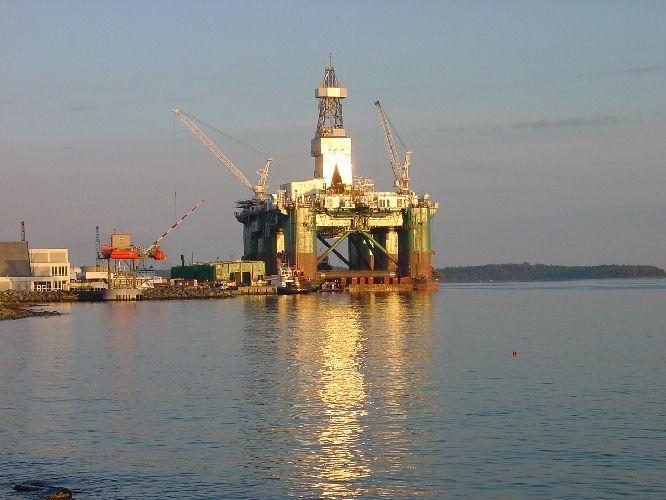
With increased exploration and development in other deep water fields, the supply of rigs that can work offshore Newfoundland is tight, as a recent public meeting on the province's upcoming energy plan was told. Nonetheless, the Erik Raude, a semi-submersible shown in the picture at right, and the Rowan Gorilla VI, a jack-up, will both be drilling exploration wells this summer.

East coast Canada is very much a frontier region in the oil and gas business, which is code for high cost and high risk. Technically challenging from an engineering perspective, a well offshore may cost as much as $100 million to drill. Improvements in seismic technology has reduced the risk of producing a duster - a dry well - but the risk remains.

The region also brings with it a political and regulatory issues that add further costs. One recent comparison showed that it may take twice as long for a proponent to get production approval offshore Newfoundland or Nova Scotia as it would in the North Sea or the Gulf of Mexico.

The regulatory issues are not insurmountable. Both the Government of Canada and the Government of Newfoundland and Labrador have expressed an interest in streamlining the regulatory requirements for exploration and have taken preliminary steps to do just that. The Atlantic Canada oil and gas industry has also pressed for regulatory reform that balances the need for environmental and safety protection with the need to drill wells and bring new oil and gas fields into production.

Politically, the oil and gas industry remains a potent symbol of riches, especially in Newfoundland and Labrador, and that is reflected in the premier's rhetoric about jobs, cash and getting a bigger stake for the government in the offshore. That will be the harder hurdle to climb if the Newfoundland and Labrador offshore is to become truly globally competitive.

The provincial government and the consortium behind the Hebron/Ben Nevis development, for example, are currently negotiating local benefits and royalties but there is no guarantee the project will proceed. Premier Danny William has publicly talked of front-loading the project with added costs like construction of a local oil refinery and letting the province's hydro-electric generating company buy an equity stake in the project. As Williams told Canadian Press late last year:
The premier said as owner of the resource, Newfoundland and Labrador is seeking a financial stake in the project unless the companies agree to build a refinery in the province or hand over higher royalties.

"We'd love to take a stake," he said. "By getting a piece of the action, not only do we get a return and some of the profits from the dividends, but at the end of the day we will have assets that are worthwhile."
Both the Hebron consortium and Williams have set April 1, 2006 as the deadline for achieving an agreement on Hebron. That's slightly less than a year after the consortium reached an operating agreement among themselves for the project. Whether or not an agreement is reached with the provincial government may depend in large measure on where the economic tipping point is for developing an oil field in the already high cost offshore frontier.

Williams' other dream, of having a provincial Crown corporation operating in the offshore may depend, ultimately on the province's willingness to undertake the risks private sector companies have been taking for the past 40 years. Talks to gain an equity position on existing projects are rumoured to have run into flat-out opposition and repeated efforts to acquire the federal governments shares in the Hibernia project have similarly met with no support from either the federal Liberals or the Harper Conservatives.

Ultimately, in order to get a direct stake in developing the offshore beyond the government's political and regulatory control, Williams may have to invest in exploration licenses and doing all the grunt work of finding oil and gas in the north Atlantic. That's the tough and costly way, but there may well be no realistic alternative.

With frontier oil and gas, those who take the risks reap the rewards.