21 October 2005

Hydro not bled white or dry or anything else - amended

Premier Danny Williams loves hyperbole.

That is exaggeration, usually for effect, but typically for its own sake.

You've heard it before: "The debt and deficit was the worst in the history of mankind on the planet. I performed a miracle [almost a verbatim quote] and magically reduced it in less than a year to a manageable size. David had nothing on me. I slay giants in my spare time."

That sort of stuff.

Looks funny when you write it down. It's amazing the number of people though that will listen to that stuff and bob their heads up and down in agreement that surely this Messiah is the true one. [Unlike all the other ones we've bobbed our heads for. The last hyperbole freak was Tobin, before that it was Peckford and before that Smallwood, the Superfreak of hyperbole freaks.]

Anyway, in an interview with David Cochrane on CBC Radio this morning, Premier Danny Williams proudly announced that government is going to stop taking dividends from Newfoundland and Labrador Hydro PetroNewf to balance the provincial books.

This is good. It's a simple announcement.

The reason? Well, for one thing the oil money flowing so heavily means that the province doesn't need the Hydro cash desperately like it did say 12 years ago. For another thing, the Premier wants to leave all of PetroNewf's money with PetroNewf so it can do things like buy an equity stake in the offshore.

He said something to the effect that PetroNewf was being bled dry and its debt run up by government taking out cash which, of course, sent the patented Spin-o-meter into the redline.

Ok. There are two separate issues here.

One is the debt increase at PetroNewf. That was caused by PetroNewf building a bunch of new hydro generation projects.

The second was the issue of taking dividends - drawing from PetroNewf's annual net profit - to balance the books.

Here's what that looks like.

According to its 2004 annual statement, PetroNewf has in the bank doing nothing about $350 million labeled "retained earnings". Another for it is accumulated net profit - the money left after all the bills are paid. It is down slightly from the early 1990s when the retained earnings were over $500 million.

The thing is that back in the days when it was Hydro, PetroNewf made money just about every year. The government started taking a dividend in the midst of the truly worst financial crisis since the collapse of Responsible Government when they needed it. Until Tobin arrived, that money was always the current years earnings which meant that the little nest egg of retained earnings was never harmed.

Brian Tobin and later Roger Grimes started dipping deeper into the pot. If you check the 2001 PetroNewf annual financial statement, the retained earnings are where they were a decade earlier - over $500 million. There has been a decline in this surplus cash on hand since then, but even after the Grimes draw-downs, and paying off Brian Tobin's $57 million Lower Churchill slush fund, PetroNewf has hardly been bled even to a shade of cream, let alone white.

With that bit of prime ministerial exaggeration out of the way, maybe we can take a look see what it would cost to purchase an equity stake in the offshore.

The future of Hebron and gas development offshore Newfoundland and Labrador

Having worked at NOIA for a short period, I decided to take a second look at the conference next week focusing on future offshore developments. It's sold out, so don't bother trying to get tickets.

No doubt people have been buying up luncheon tickets to hear PetroNewf chief executive officer Ed Martin explain how a Crown corporation with absolutely no experience in oil and gas is somehow going to muscle its way into the oil and gas business.

The real value of this conference is the working sessions [see agenda] and anyone with tickets is going to get a real earful of solid information.

The morning sessions focus on heavy oil and the Hebron project. It promises to be a heavily technical discussion.

The provincial government and the companies are still trying to figure out a benefits deal, so the project is not ready for sanction, that is, it isn't ready to go to the offshore board for approval. Premier Williams appears to be trying to saddle Hebron with a host of "local benefits" that aren't needed to bring the field on stream, which will drive up the cost of development and in the process might well reduce the revenue stream to the provincial government - much like the Peckford-era Hibernia deal.

At some point - maybe in four years time when Danny Williams is out of office - the companies can cut a deal with the provincial government and the project will finally start. Major international companies like Chevron make long-range plans, and as the Kazakhstan projects demonstrate, they are quite prepared to work diligently over a long period of time for the right moment to develop the right oil field. Having spent 20 years waiting to bring Hebron on stream, the consortium can hardly be deterred by the prospect of waiting for a few more years just like INCO waited for Brian Tobin to get bored.

In the meantime, Martin and Williams will try and build PetroNewf into something that will either compete with local private enterprise or, more likely, just muscle local companies into a subordinate position in the oil patch.

(Left) TengizChevroil logo

For anyone who thinks that Hebron is a big play for Chevron and the other partners, think of this. Since the late 1990s, Chevron has been heavily involved in developing oil reserves in the former Soviet Union. In 2001, they opened a new pipeline to take gas from the Caspian Sea to market. The Tengiz field, for example contains an estimated six to nine billion barrels of oil.

Compare that to the 700 hundred million in Hebron, most of which is heavy oil that is costly to produce especially in the harsh North Atlantic environment.

The afternoon sessions on potential gas development promise to be more interesting, especially in light of the Premier's comments to The Telegram about not wanting to see gas stuffed into a "God damn boat" and floated down the coast, presumably to markets where people could actually buy the gas.

The Premier's comments are odd, since there is a very small potential market, if any at all, for natural gas within the province.

In 1998 and 2001, NOIA conducted a two-part study into potential gas development. You can find Phase One report, or scoping study, here and the Phase Two report, which examined critical issues, here.

The market analysis carried out in 2001 by ICT Consulting predicted continued strong growth in American natural gas markets and that has held true. Likewise, the assessment that there is a limited local market for these products has also remained true.

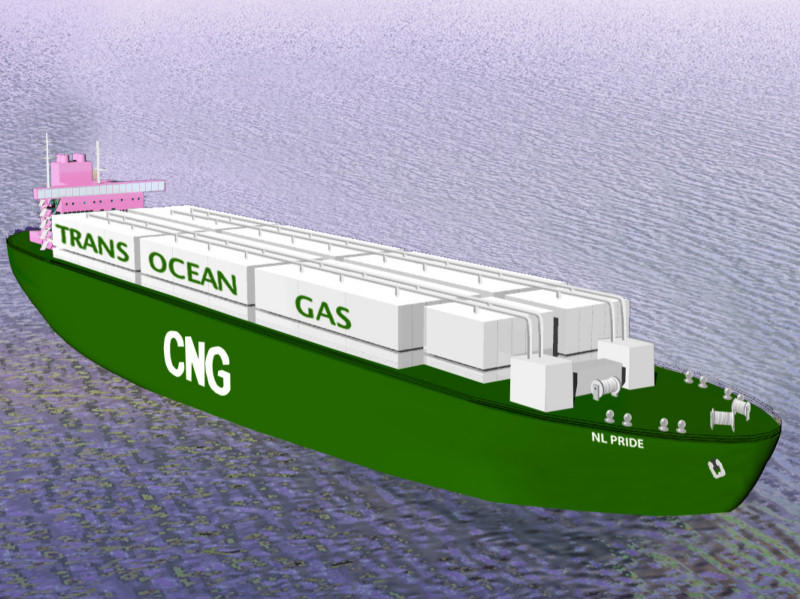
(Right) One of the Premier's despised "God damn" but locally-owned compressed natural gas ships could earn the province millions in added revenue through the private sector.

Technological changes, including exploration of new shipping technologies with local business ties, open up new ways of exploiting the estimated eight trillion cubic feet of natural gas offshore Newfoundland and Labrador.

Given that these studies are about five to eight years old, it might be timely to have another look at the potential to develop gas reserves. Changes in price, for example may make it more attractive to begin development of something less than the total available reserves, with production commencing around 2010 or slightly afterward. The one thing that isn't likely to change is the small local demand for natural gas.

20 October 2005

Lucid Lucien


While the story got some coverage, Lucien Bouchard's news conference the other day didn't get quite enough.

So here is a link to the English version of the manifesto he released on behalf of a group of Quebec intellectuals on the challenges faced by Quebec in the coming decades and some possible solutions.

The French name of the document, pour un Quebec lucide, seems much more compelling than the English version: For a clear-eyed vision of Quebec.

I'd agree with Paul Wells on the most striking statement in the document, albeit for different reasons. Irrespective of Wells' point, I just thought the comment equally applicable to Newfoundland and Labrador in the past 18 months; just change the provincial origin of the "consensus".

I'll give you the Wellsian translation of the original French:

"The first condition of liberty is the ability to question the status quo without being hauled before the inquisition tribunal of the Quebec consensus."

On that note, stand by for some further comment on this manifesto in the days ahead.

Orrin Hatch - honorary hoser

Check out this post, in which United States Senator Orrin Hatch (Republican, Utah) claims that Canada will surpass Saudi Arabia as the world's largest oil storehouse.

Then check the text of Hatch's speech, from his senatorial website and find out exactly what he actually said:

"We should take note that our major oil companies, including Chevron and ExxonMobil, are beginning to state publicly that we may be reaching peak oil. And with the economic growth in India and Asia and other regions, it looks like weÂ’ll have high oil prices into the foreseeable future.

This is a new scenario for the world, and it forces us to shift our focus to our unconventional resources. Shell Oil Company has, for years, been preparing for such a shift. Its successful activities in Alberta with oil sands and their investment in new technologies to produce oil from oil shale are a testimony to ShellÂ’s recognition that unconventional oil is in our future.

Those who doubt that unconventional fuels are economically viable probably are suffering from a neck ailment that keeps them from looking north.

The 800-pound gorilla is sitting just above Montana, and let'’s face it, it'’s hard to miss.

Alberta is now second only to Saudi Arabia in proven oil reserves and ninth in the world in annual oil production. This is owing mostly to their successful development of oil sands. In Alberta, you have dozens of major oil companies, using a variety of technologies and recovery methods, going after very different types of oil sands resources, and in almost every case doing so for less than $20 a barrel, including during their very tough winters. It is a gigantic success story, and it began with Alberta'’s government deciding to promote the development of this resource and not giving up.

Anyone watching what is happening up north will recognize that, before long, Canada will inevitably overtake Saudi Arabia as the world'’s oil giant. And Alberta clearly has its sights on increased annual production to match its growing reserve. Already at about a million barrels a day, Alberta'’s production is expected to double in the next five or six years."

Notice that the gentlemen Senator did not mention offshore eastern Canada in the speech.

Maybe he has just been lobbied hard about Alberta. Maybe Hatch just knows about Alberta because his own state also has large oil sands reserves.

It is still interesting to see Canada noticed in this way by an influential senator.

The Williams oil and gas corporation - institutionalising dependence

When Danny Williams released his Blue Book, it appeared to contain a contradiction. Thanks to Rob Antle's story in yesterday's Telegram, the contradiction is now more apparent.

The first chapter of the Blue Book copied almost word for word the Wells' administration Strategic Economic Plan (SEP). The SEP aimed to correct two fundamental weaknesses in the Newfoundland and Labrador economy, namely excessive dependence on a handful of major resource industries on the one hand and a shortage of local, accessible capital to support economic activity. Since Confederation, the latter weakness had been addressed by federal transfer payments which had resulted in another form of dependence.

In some respects, these twin dependencies were historic issues. The pre-Confederation economy depended on the fishery, forestry and mining with the former being prominent. Local manufacturing was dependent as well, although before 1949, it relied on protectionist tariffs to keep Canadian manufactured goods out. Such was its level of dependence that within three months of Confederation, most of those manufacturing enterprises collapsed in the face of more robust and efficient business elsewhere.

The SEP identified entrepreneurship - the growth and development of the private sector - as the mechanism by which the Newfoundland and Labrador economy could be strengthened and the twin dependencies eliminated.

By contrast, the second chapter of William's Blue Book dusted off industrial development policies from the 1970s and 1980s with its focus on oil and gas as the means of generating cash for the provincial government. The Peckford administration viewed oil and gas as the sole means of financial salvation for both the Newfoundland government and for its society.

Peckford passed legislation to create the Petroleum Corporation of Newfoundland and Labrador, with its legislated 40% share of each offshore development. Coupled with that, the legislation mandated that companies involved in the local offshore would be local companies. Through these legislated requirements the province would develop an oil industry that would ensure, in the words of both Peckford then and Williams now, that maximum benefits would flow locally from local resources.

The fundamental contradiction between these two approaches is that while the SEP is based on private sector entrepreneurship and increasing international trade for local products, the Peckford and now Williams approach is focused on state ownership of industry and on local markets.

A genuine contradiction would exist if the Blue Book embraced the philosophies underpinning the Wells and Peckford approaches. It does not. Rather, Williams appears to be focused on control as an end in and of itself. For example, take this phrase dealing with prospective hydro development: "I'’d like to see us own the lion'’s share of the Lower Churchill...". The provincial government already owns the "lion's share" and can claim rents from electricity as a matter of owning it.

What Williams is talking about here is owning and controlling the company which generates the electricity.

Consider as well, the rest of that section of Antle's story: natural gas should be brought ashore in Newfoundland and Labrador by pipeline so that "we have control of the pipeline so that it'’s not being compressed or liquefied and going in a God damn boat and going on down the coast somewhere."

In the absence of any demand for natural gas within the province or any demonstrable advantage to converting the province to gas, an entrepreneurial approach would support selling it to someone who wants it. Better to ship it to the United States in whatever way produces the best price than to spend money bringing it to a place that has no use for it. Revenue from that sale can support public services like health care. Privately owned local companies can own the ships that move the gas to market. Expertise in gas production and shipping, potentially using new technology, can give the local private sector a competitive advantage such that it can gain even more business around the globe than can be obtained purely within Newfoundland and Labrador.

A government dedicated to developing the private sector would create a climate in which local companies can exploit local resources thereby generating wealth. Government's share of that wealth through economic rents and other taxation would give sufficient revenue to deliver government programs and services.

In the Williams approach, the state - the provincial government - is merely a corporate entity with all the tools necessary to achieve local, i.e. provincial government, control.

The struggle for the Williams government is the struggle for control. He acknowledges that his supposed opponents are larger than government: "if you go up against Hydro Quebec, if you go up against Inco, if you go up against ExxonMobil, they'’re a lot bigger than our government is. That'’s the grim reality of all of this." His next comments identify the solution - build the hydro corporation such that it can "take on" the biggest out there.

The result of the Williams approach is difficult to predict. Certainly, in the short run, he may achieve considerable political success. He may be able to turn the energy corporation into a Mother Hen that will wrest a portion of economic developments for itself and then distribute these among local companies. The resulting jobs may carry with them votes.

In the medium- to long- term, though, the Williams approach cannot address the chronic, historic problems in the local economy. Over the past 25 years, Western economies have disposed of state-owned enterprises since they are notoriously unable to produce wealth as effectively and efficiently as the private sector. The ones that survive, such as Quebec's hydro corporation may be models for the Premier, but they are models from the past. They are models which are limited to very specific and primarily local activities. In short, they are expensive and ultimately wasteful of what in Newfoundland and Labrador are scarce cash resources.

The Williams Mother Hen approach - if that indeed is what emerges - will simply promote
dependence of local companies on state subsidies, either directly or indirectly.

The Premier's plan may not succeed simply because the hydro corporation is actually not the entity Premier Williams describes. Newfoundland and Labrador Hydro remains a government department in all but name and is almost the antithesis of a private sector corporation in which the board of directors would have the authority to run the company and set its own lines of business.

On the face of it this is obvious: the impetus to change hydro to an energy corporation did not come from its own board, complete with a business plan. It is entirely the plan of this particular administration. The board will not resist. The Premier alone holds the de facto power to appoint or remove directors and he has shown repeatedly his willingness to replace dissenters with his own personal retinue.

As such, the new energy corporation will likely be quickly recognized as an anomaly in the developed world and surely one which violates the Organization of Economic Co-operation and Development's guidelines for the governance of state-owned enterprises. Even if one leaves aside for the moment the nagging and very serious question of how the new energy corporation will find the cash to support the Premier's ambitions, one can readily see how companies such as Chevron may be very reluctant to enter into any arrangements that would see its long awaited return on investment siphoned off into a provincially owned company with no experience in oil and gas and no capital at risk. These companies are not Fishery Products International.

International companies may well become increasingly reluctant to invest in this province as the Williams' approach becomes better understood. International capital seeks stability and predictability as well as a fair and transparent regulatory regime. In the case of the offshore, it appears from the Premier's interview yesterday and his previous comments on the offshore board that he intends to change the rules as he sees fit, when he sees fit.

Premier Williams may succeed in creating some measure of the control that he finds satisfying personally. On another level, however, all he may succeed in doing is ensuring the chronic problems in the Newfoundland and Labrador economy continue into the future, at best unaltered and at worst supported by the very mechanisms of control which he is seeking.

In reforming the hydro corporation, he may well be using the elements of plans laid by previous administrations to cement in place the very circumstance they sought to change.

19 October 2005

Steele chairs offshore board selection panel

Harry Steele, chairman of the board of Newfoundland Capital Corporation, will chair the three member panel to select a new chair and chief executive officer of the Canada-Newfoundland and Labrador Offshore Petroleum Board (CNLOPB). Here's the VOCM story.

Steele's appointment means the panel can get down to work and finish the job started last year by a team chaired by Robertson Surette, the national executive search firm.

It also likely means that there is little chance Andy Wells will survive to take the job, much as pointed here back in July when Andy leaked the story to local media. Wells is demonstrably not qualified for the job. Steele didn't make millions over the years by putting unqualified people into jobs.

Herbicide Orange in Newfoundland and Labrador - updated

Update: Here's the CBC television story on Agent Orange, complete with pictures. (Note - needs RealPlayer)

It took a while to make it on the air, but this October 13 news release from Liberal Opposition environment critic Percy Barrett calls on the provincial government to investigate possible use in Newfoundland and Labrador of Herbicide Orange, commonly called Agent Orange.

There are several possible sites where the herbicide could have been used in the 1950s and 1960s, including the American bases at Stephenville, Pleasantville (St. John's), Argentia and Goose Bay and Canadian military sites at Torbay, Gander and Red Cliff, near St. John's, as well as other Pine Tree radar sites.

There were also some gap-filler radar sites in other parts of the province.

(Left) Aerial photograph of ruins of Red Cliff Pine Tree Site, near St. John's, May 2005


Perhaps the best known use of the herbicide is Operation Ranch Hand, a series of sprays during the Vietnam War designed to reduce jungle coverage used by North Vietnamese and Viet Cong troops as cover.

Recent news stories indicate that Herbicide Orange was also used at Canadian military bases, like Camp Gagetown in New Brunswick. This website is related to claims by veterans and civilians that exposure to Herbicide Orange made them sick.

Provincial environment minister Tom Osborne is dismissing Barrett's claims as fear-mongering. Nonetheless he has written to several civilian companies inquiring about their possible use of Herbicide Orange.

Unfortunately for Mr. Osborne, Herbicide Orange was developed exclusively for military use. It was never sold to civilian companies or non-military government agencies.

Orange was a combination of two other herbicides: 2,4-D and 2,4,5-T. Those plant-killing chemicals may have been sold separately under different names, just as they were before they were combined as Orange.

They are still available for commercial (i.e. public) use across Canada.

(Right) Accompanied by a T-28 Trojan, a United States Air Force C-123B Provider returns to base from a spray mission as part of Operation Ranch Hand, somewhere over South Vietnam.

A modest proposal - updated


[Left] Her Majesty's Penitentiary, St. John's
Viewed from The Boulevard, looking south

Amid some calls today for the provincial government to replace Her Majesty's Penitentiary (HMP) in St. John's, the following thought crossed my mind.

Erected in the 1850s, HMP is one of the oldest buildings in the province and remains the largest provincially owned jail. The original section is long past due for replacement since it is too cramped, cold and damp for use as a modern correctional facility. It was renovated in 1945, 1981 and 1994 but the site is not really open for expansion of substantial alteration.

HMP was practically in the woods in 1850 when St. John's barely spread up from the harbour as far as Military Road. Today, HMP is smack in the middle of one of the tonier neighbourhoods. It is run-down and the exterior is poorly maintained.

[Left] HMP, from Forest Road looking north

So here's the thought.

Rather than renovate Colonial Building so that it can house a handful of heritage not-for-profit groups, why not turn the Colonial Building into either the legislature (again) or into an adjunct of the legislature.

In the meantime, build a new prison somewhere. I am thinking Stephenville can use the boost to the local economy. Once the old HMP is closed, tear down some of the newer bits and restore the 1859 building as an historic site. Between the office buildings associated with the prison and some of the other buildings (not the cells), there is plenty of space for even more non-government groups than the eight or so that will get to live in the Colonial Building free of charge. You and I may well be subjected to a fee to get into the building.

Here's the CBC story on the HMP issue.

Sensitive Connie

Thanks for the free link, Liam O'Brien.

Note to Liam -

1. Relax: Everyone knows you are a Connie. You don't have to keep struggling so damned hard to remind people all the time.

2. In most political parties, it's ok to be a little upset with either party officials or cabinet ministers. You were a tad miffed and everyone is grown-up enough to understand you loved the convention and had a great time and were just a little breathless in your praise. The lengthy explanation changed the tone of your own original post.

3. Odd you didn't notice the rest of my post which complained about the lack of information about the convention on the provincial party website.

4. Odd too that you didn't notice the other post on Danny Williams' speech and leadership style. Maybe there's another post coming. Maybe, just maybe, your silence on this point suggests you agree with me that Danny Williams' leadership style is pretty closed to discussion.

5. The spin thing is as tired as the "no comments" thing. And as I noted in your comments section it is a bit silly to accuse someone else of spin - lies, bullshit - and then turn around and accuse the feds of bigotry, a truly offensive word, without any provocation or cause.

18 October 2005

The strangest things Google (tm) can find

In searching quickly for a picture of the Pen here in St. John's, I got this hit back from google(tm).

It is a paper by eminent historian Peter Neary on venereal disease and the administration of public health under the Commission of Government [1930s and 1940s].

Fair warning: There are some grim descriptions of disease in this paper, including one of a child admitted to St. Clare's Hospital but subsequently treated successfully with then-new penicillin.

Other than that it is a fascinating glimpse into the relatively recent past.

Where are the results?

Further to the weekend Progressive Conservative Party convention, can anyone explain why the official party website contains only a thank you to everyone who turned out?

The site, which is little more than a reposting of government news releases, has absolutely no information on the convention.

There's no agenda, no list of resolutions, not even a note telling you what to show up to worship Stephen Harper.

Nada.

Zip.

Bupkis.

How odd.

Then again, if all everyone is expected to do is merely fall in line behind The Leader, then there isn't much need for us to bother our pretty little heads with nasty old details and such.

Over at Responsible Government League, aka Really Groovy Lundrigan, Liam is rotted at not being able to get a floor resolution debated and for finding out that Trevor Taylor doesn't really support joint management of the fisheries as does Mr. O'Brien.

Liam also waxes nostalgic for John Lundrigan. That's a bit like a Grit getting all misty-eyed about Dave Rooney, the former Liberal member of parliament for Bonavista-Trinity-Conception.

Dave's lasting contribution to parliamentary lore was submitting stuff to National Lampoon [The Real One]. One that I recall was a Telegram piece on the local exotic dance industry with the actual headline "Stripper bares all". The other was a highway sign pointing to Heart's Content in one direction and Dildo in the other.

17 October 2005

The I in t-e-a-m.

In both his speech to the provincial Tory convention this weekend and in his guest editorial in The Independent, Danny Williams gave us a succinct and eloquent description of his approach to politics.

His job is to provide leadership, tough but smart leadership in the the words of his Spindy editorial.

Everyone else's job is to stand shoulder to shoulder behind him.

It's a pretty simple leadership style.

There's is no room for debate or discussion, at least not on matters of substance.

That philosophy goes a long way to explaining why he labeled some of his critics in Stephenville as dissidents simply because they didn't readily accept either his explanation or his actions. The Premier didn't mean the term as a compliment or a simple statement of fact; he meant that they were out of position and would be well advised to get back in line behind him.

It also explains why he keeps going back to the offshore discussions. His own failure to achieve even one tenth of what he promised is irrelevant. The episode has been sold as a success and the value of the entire wrangle with Ottawa is, as he notes in the speech, what happens when everyone stands behind him.

More than anything else, the Danny Williams definition of team also explains his problems with a number of people who, in fact just are coincidentally women. The major problem for Elizabeth Marshall, Flo Delaney, Anne Marie Hann and Debbie Fry wasn't that they were strong women. Nope. The problem was they did not agree with him readily.

Ask Fabian Manning about that sort of thing. While a number of political observers expected last weekend's convention to be the place where Fabian would be accepted back into the Tory fold, they saw instead that Manning is still being punished for disagreeing with the Premier on fisheries issues. Ironically though, Fabe got more media coverage on himself - and the fact he has been Tory since before Danny was a twinkle in someone's eye - than the Premier got.

In some respects, Danny Williams is a common type in post-Confederation politics in Newfoundland and Labrador. Smallwood was a local caudillo or strongman. He ruled everything in the province for 23 years. Brian Peckford copied many of Smallwood's approaches to governing, as did Brian Tobin.

The next couple of years will be interesting to see which of those three politicians Williams resembles the most.

Coming soon to NTV?

I noticed it.

One regular reader of these e-scribbles came to the same conclusion and flipped an e-mail over the weekend to point it out.

Head to the Viral Factory website.

Click on work and make sure the "Ravenstoke" clip loads. It's a piece of viral marketing in the style of a news report.

Notice the "reporter", whose name is given in the piece as "Chuck Peterson".

My guess is the guy playing Chuck is actually Glenn Carter, NTV's new reporter/anchor.

The son of former provincial cabinet minister Walter Carter recently returned to the province from Alberta.

The question is, did Carter spend anytime in Alaska or in a part of Alberta that was pretending to be Alaska.

Incidentally the fake news report is hysterically funny, especially right at the end where "Chuck" keeps a straight face while in the background two Grizzlies get a little amorous.

14 October 2005

Dress and heels, Rick? That would be the navy.

Gordon O'Connor, Connie defence critic is a former Army type.

Rick Mercer rips him a new one in this post about a planned trip to entertain our troops in Afghanistan. It was supposed to be a secret trip - Rick points out it was being kept quiet for security reasons.

It was secret until the Sun chain blew that away and then guys like Gordo piled on for their own partisan purposes.

Viral marketing

One of the latest marketing phenomena is so-called viral marketing. It's based on the simple idea of having your message carried for free via e-mail and similar methods by the target audience members themselves.

There's even a company that calls itself the Viral Factory, specializing in exactly this type of selling approach.

Ads for the Ford Sportka, a compact marketed in Britain were among the first virals I ever came across. They wound up in my e-mail inbox as an attachment from a friend of mine. There were two. One is the bird version found on the Viral Factory website. The other was my favourite.

It was startling and hysterically funny, in a sick, twisted kind of way. It fits the viral bill perfectly because while the bird ad - the car bonnet swats a bird that flies too close (birds crap on cars; this car gets its vengeance) - might theoretically make it to commercial television, on the Internet you get three advantages:

1. You do NOT have to pay for placement. People circulate your stuff for free.
2. You do NOT have to navigate the sometimes painfully bureaucratic world of getting your ad cleared by the lawyers to air on television.
3. Your single ad is almost universal - there is no need to produce a version in different languages or suited to particular cultural sensitivities.

Yes, you say, but cable has become so risky that anything goes. True, but there are still boundaries.

In a genuinely successful ad, the news media will pick it up, thereby adding to your reach. The client can then disown the ads and the agency - at least publicly - thereby generating even more attention for the brand.

The agency will get paid. It will likely pick up new clients and the clients will get all the advertising they need, with the right audiences and at a relatively low cost.

You and I often get a laugh.

Everyone wins.

For a Friday bit of fun, here's the cat-eating car. WARNING: This is NOT for cat-lovers or children. It is safe for work.

Air Canada sucks

Air Canuck will be charging for the use of pillows and blankets, according to this Reuters story.

Gone are the warm blankets and fluffy pillows, to be replaced by inflatable cushions and thin rags, supposedly as a cost-saving measure.

What's next, you ask?

- Passengers will be provided with pedals under the seats. It will be billed as an effort to provide in-flight exercise. In reality the pedals will power the fan blades in the engines so the plane can fly. There will be no charge for the service. Air fares will increase.

- Short-haul flights will stop pressurizing the passenger compartment in an effort to save money. Passengers will be told it is a modern way of traveling so that you arrive well-rested and seemingly younger thanks to the cryogenic properties of airline's passenger environment. The reality is passengers will black-out from oxygen deprivation once the aircraft climbs past 12, 000 feet above sea level and come close to freezing as the air temperature plummets.

People who need to stay awake and work on the flight will be able to purchase a blanket for CDN$2 and lease an oxygen tank at CDN$2 per minute. They can also purchase a stylish oxygen mask which they can take with them as a souvenir.

- In a further effort to cut costs, Air Canada will introduce self-serve cabins. Taking a cue from northern service airlines using flying culverts, Air Canuck will now ask passengers to pass around a garbage bag filled with Coke and Pepsi by the can.

- On selected routes, passengers will be fired from a large cannon designed originally by Gerald Bull. In the photo at right, a lucky passenger departs Charlottetown airport en route to Toronto.

His luggage was fired immediately after...to Winnipeg. Airline officials blamed the problem on a mistake in loading the right amount of powder.

Put me in coach

CNN covered a minor flap on Thursday with allegations that American soldiers involved in a brief question and answer session with George W. Bush had been coached. Scroll to the bottom of this link for a reference to the incident. Here's the Associated Press version of the story.

Ok.

This was a situation in which a handful of obviously hand-picked American soldiers in Iraq were involved in a televised satellite situation in which - get this - Bush asked questions of the soldiers.

The "coaching" was done by Allison Barber, a deputy assistant secretary of defence. She wasn't caught in the act, as some made it appear. Rather what Ms. Barber did was walk through the entire situation with the soldiers involved, making sure that someone was lined up to answer each of the questions to be asked, and giving the soldiers advice on what to do should the President decide to ask them a question that hadn't been anticipated.

At no point did she give them the specific answers to be provided.

As described by AP, the entire situation is simply a walk-through of the process of the exchange.

This smacks of a couple of things, not the least of which is an exceedingly slow news day.

More importantly, it suggests that the Washington Press corps thinks the Bush administration is increasingly vulnerable about the war in Iraq. The press corps seems to feel comfortable in taking a poke at not only the White House but also senior Bush administration public relations staff about events like the Bush-soldier exchange.

While it would be somewhat unusual to have media witness this sort of preparation, they all know it goes on and is an accepted part of the event. In a normal situation, this stuff wouldn't get reported because it has no news value in and of itself.

Largely for that reason and because reporters and public relations staff need to stay on productive working terms, reporters wouldn't normally blade someone like Barber. That's blade as in military slang for slipping a knife blade into the ribs of a buddy, usually metaphorically, by telling a tale to superiors to get him or her in trouble.

There's another story underneath the one reported by CNN and AP, but you won't see that one...yet.

In a related story, though, notice the reference in the AP story to Operation Truth, an anti-war website.

Leave aside for a moment the fact that this supposedly knowledgeable group's spokesperson couldn't tell the fact there was only one officer (a captain) in the Bush videoconference. The rest were non-commissioned. Beyond that also forget that given the size of the American military, these are hardly some sort of elite bunch of characters - basically the spokespersons whole carefully prepared sound bite was crap.

Notice instead the link to this blog by an American soldier serving in Iraq since at least February. Now the guy is pretty literate - no surprise there at all. Read the posts, especially the ones at the beginning and you'll see a pretty interesting perspective on the Iraq situation.

Check the archives and you can also find a link to the guy's girlfriend, complete with a couple of good pictures of her.

Then notice his post about censorship rules.

ok. What organization allows anyone in the organization to crap on it at will whenever they want? Answer: None do. Therefore it shouldn't be surprising that the American Department of Defence wants to discourage wholesale crap storms from anybody and everybody.

Beyond that, there are actually some pretty sensible reasons for restricting access to the Internet or more particularly to revealing personal details of serving personnel on a site anyone can access. Since the American military deployed to Iraq, blogs and Internet chatrooms have been clogged with soldiers of all ranks and occupations who freely reveal their names, units locations and missions to anyone who asks.

It's an intelligence goldmine - for the guys working to blow them up with car bombs.

Consider for example, that without too much checking I can tell you Daniel The Blogger's girlfriend's name, hometown and occupation. It wouldn't take much searching to find something a lot more specific. It wouldn't take too much to find some potentially useful information on Daniel that could be used to advantage - against Daniel and against his buddies.

While Daniel and Holly might be a bit more difficult to locate, get a load of this guy. It isn't clear if all this stuff is actually approved or if it is just going on largely unchecked by military authorities. Follow some of his links and you'll even more military bloggers plus a bit of a controversy over whether milboggers as really bloggers or just agents of Department of Defence propaganda. [roll eyes in head]

There's a story in this stuff AP could be telling.

I never met Daniel or Holly but I just hope he gets home to her in one peace. [a Freudian slip, but I decided to leave it in after editing]

Stay low and keep moving, Daniel.

As bizarre goes

Yet another bizarre e-mail resulting from the posts on the Colonial Building.

This one contained nothing more than a quote from Nicolo Machiavelli's The Prince, in Latin no less, from the chapter "An exhortation to liberate Italy from the Barbarians".

I'll give you the English, as found here:

"With us there is great justice, because that war is just which is necessary, and arms are hallowed when there is no other hope but in them."

That was followed by a comment that seemed to indicate it would be just to take arms if the arms, in this instance serve to sow confusion among "the followers of Luther".

Who needs a comments section on the ole blog when the e-mails yield this sort of humour from someone who seems sectarian enough to still be fighting the Reformation and sees in relatively ordinary things great plots and conspiracies?

Your United Nations money at work

When the Smurfs were just a sickening kiddie fad, some of us used to joke about a campaign to eradicate the pesky aquamarine creatures accompanied by the slogan "What is that blue goo on your shoe?"

Well, that was a sophomoric joke.

Then there's this thing from UNICEF, the United Nations children's fund. You can find some clips from the video here with reporting in Flemish or French. That doesn't matter since the images themselves are shocking.

If you look closely at the animated version as opposed to the stills, you'll notice that no Smurfs get killed. They get bounced around a lot, but for some inexplicable reason they don't actually die.

So, some of us are left scratching our heads at the purpose of this little piece of animation. One of the complaints about slapstick animated comedy like Wile E Coyote and even the old A-Team was that there were no logical and hideous consequences to shooting people, blowing them up or dropping them off a cliff.

Pray tell what is the difference is here.

Bad release; great video

Anyone familiar with Black Hawk Down will recall the scene where one soldier removes some plates from his frag vest because they are too heavy in the hot Mogadishu sun and, after all, he thought he'd never get shot in the back.

He got shot in the back.

This soldier, on the other hand, is clearly well disciplined.

His discipline saved his life in a sniper attack.

The video, taken by the sniper team, was captured along with the sniper. It is truly amazing There's an excerpt here. You'll need Windows Media Player to see it.

The army public affairs news release, on the other hand, is something my students would never have produced. It is appallingly bad, as these things go and the dorky picture makes a competent soldier look like...a dork.

Incidentally, note that the guy is a medic.