Sometimes, it is just amazing how crucial pieces of information can be deliberately omitted from a significant announcement and no one seems to notice.
Newfoundland and Labrador Hydro announced on Monday it would be awarding a contract to construct a wind generator site on the Burin Peninsula to a consortium led by an Italian firm experienced in wind generation of electricity.
Hydro Corporation chief executive officer Ed Martin described the project this way in a news release:
"NeWind submitted a comprehensive, cost-effective proposal for wind power...".
So how much will it cost?
Search in vain for any indication of the project cost. That's because Martin doesn't know. One of the things he admitted at the news conference announcing this project is that he now has to sit down and negotiate a 20 year-term power purchase agreement with the project proponents.
To paraphrase Martin's announcement then, it looks like this:
"We are building this amazing electricity generator that is cost-effective. We have absolutely no idea how much it will cost but we can tell you it is cost-effective."
Sounds like the Lower Churchill.
Without a business plan, or even a preliminary cost-benefit analysis, Martin and his real boss, Premier Danny Williams, committed the province to a project that if completed will double the province's debt. Plus they committed to the project in a way that made it extremely difficult to proceed successfully.
How difficult?
In a scrum last week, Danny Williams admitted that if he can't get a perfect deal, there will be no project.
Yeah.
Riiiiiiiiiiiiight, as Dr. Evil would say.
So there is a commitment to a project that will not appear at all if it is not perfect and, in the windy power project, there is a commitment to a cost-effective project yet the guy making the announcement has no ideas what the costs will be.
Incidentally, no one seems to have noticed that this project is not the result of some sort of magical post 2003 process. Yeah sure, Newind answered a proposal calll that Ed and his boss issued and they will be issuing more calls.
But NeWind is building off its experience in a project begun in 2001.
That project size? Five to 25 megawatts as a demonstration project.
03 October 2006
02 October 2006
Brand launched tomorrow; Bond already told you
The worst kept secret in town was confirmed today:
Danny Williams will be launching the new provincial brand at a news conference tomorrow.
Bond Papers told you about it a week ago. We also discussed the whole issue of "branding" the province back in march.
For the past week, hundreds of people have been receiving cryptic letters inviting them to a splendiferous, monumentalous phatasmagorical event in the province's history.
But they wouldn't say what it was for people who might have other things to do that day.
People on school boards wondered if it was an education announcement. People on hospital boards wondered if it was about health care.
Members of parliament wondered why Danny wanted them in St. John's rather than in Ottawa - where they belong - representing their constituents.
But the crafty crowd in the Department of Business just gave every inquiry the business. The jazz. The run-around. The waste of time.
Like the brand.
If the print ads and television spots already running are anything to go by, we can say three things up front:
1. The name of the province is now being presented in Danny-blue. Now there's a non-partisan rebranding if we never saw that old chestnut before.
2. The brand messaging is all focused inward, rather than outward. In itself that is nothing short of bizarre.
3. Someone made a heckuva lot of dough for a lick of blue paint and a bunch of hoary lines that sound more like the start of the Danny-brand's next election campaign rather than an effort to re-focus the province.
Oh yeah and after three years effort, tomorrow's launch represents the only accomplishment of the Business department to date.
Danny Williams will be launching the new provincial brand at a news conference tomorrow.
Bond Papers told you about it a week ago. We also discussed the whole issue of "branding" the province back in march.
For the past week, hundreds of people have been receiving cryptic letters inviting them to a splendiferous, monumentalous phatasmagorical event in the province's history.
But they wouldn't say what it was for people who might have other things to do that day.
People on school boards wondered if it was an education announcement. People on hospital boards wondered if it was about health care.
Members of parliament wondered why Danny wanted them in St. John's rather than in Ottawa - where they belong - representing their constituents.
But the crafty crowd in the Department of Business just gave every inquiry the business. The jazz. The run-around. The waste of time.
Like the brand.
If the print ads and television spots already running are anything to go by, we can say three things up front:
1. The name of the province is now being presented in Danny-blue. Now there's a non-partisan rebranding if we never saw that old chestnut before.
2. The brand messaging is all focused inward, rather than outward. In itself that is nothing short of bizarre.
3. Someone made a heckuva lot of dough for a lick of blue paint and a bunch of hoary lines that sound more like the start of the Danny-brand's next election campaign rather than an effort to re-focus the province.
Oh yeah and after three years effort, tomorrow's launch represents the only accomplishment of the Business department to date.


01 October 2006
Harper wants equity stake in Lower Churchill
According to the Globe and Mail, the federal government is considering an equity involvement in the Mackenzie Valley pipeline but has ruled out direct subsidies and loan guarantees as a way of helping the costly venture along.
For its part, Imperial Oil is just saying a polite "no" to equity stakes.
Meanwhile, Imperial is having trouble getting the permits needed to build the project. The problem is not with the company but with the federal government's inability to make appointments to four boards that must oversee the permits.
The permits are just one issue affecting go-ahead with the natural gas pipeline that is estimated to cost $7.5 billion to construct.
But here are a couple of observations on this issue and how it relates to Newfoundland and Labrador:
1. No one else wants to be President of Parador... except Danny Williams.
Some people compare Danny Williams to Hugo Chavez. I say the comparison is more like Danny Williams and Adolphe Simms, except Williams is not an actor playing the role.
Too bad.
Then maybe he could take some advice.
But I digress.
The equity stake discussed in the Mackenzie Valley pipeline stories linked above is being considered purely as a means of providing financial support to the project. Williams has just loaded the whole concept with so much emotional baggage he has actually managed to sink Hebron for years and may well have further discouraged any further development offshore, let alone exploration.
2. Regulatory Boards are important. Note that this project is being held up because the government involved can't sort out its appointments to the regulatory boards involved.
The board regulating the local offshore did quite well despite being set back in its timelines as the Premier demonstrated not only his political impotence but also - apparently - a doubtful ability to read and comprehend the law through the Andy Wells fiasco.
Maybe Jim Bennett could have asked Danny for advice on how to handle having as Supreme Court justice toss your arguments out the window as so much codswallop.
Anyway...
Regulatory boards are a key part of the system. The feds need to get that boards issue sorted if they want the Mac pipeline to proceed. Around here, things might have gone much more smoothly if Danny Williams had let the original selection process proceed, rather than try to put in the fix on Hebron using Andy Wells.
3. Kiss the Lower Churchill goodbye too... unless.
The federal government - the current one - has no interest in provided loan guarantees to megaprojects let alone megalomaniacs trying to run megaprojects.
Stephen Harper has been perfectly consistent on this point.
Just recall what Harper actually said last winter, instead of what Danny Williams told you Harper said.
Harper actually said he was prepared to support the Lower Churchill in the same way the feds supported Hibernia. This is how he put in the formal reply to Williams' wish list during the last election. Since Danny places so much stock in the written word - when it is convenient - then here are the words, as written by Harper:
It needs partners.
The only way the feds will help is in the form of an equity position.
Meanwhile, Hydro Quebec is moving ahead with its own megaprojects that will likely start construction and achieve first power well before the Lower Churchill, even under the most optimistic situation. They stand a good chance of getting capital and the markets that would otherwise go to Lower Churchill simply because the provincial government here miscalculated yet again on a big economic project.
So the issue for Danny Williams comes down to this: is he prepared to let Stephen Harper acquire an equity position in the Lower Churchill project that would let Williams build the project at all?
Is he prepared to treat the Government of Canada just like Altius, for example, which is seeking an equity stake as well?
The one thing that doesn't seem to be in question:
There'll be no federal loan guarantees for the Lower Churchill, at least not under a Harper government. And without the federal government's deep pockets, there won't be a Danny Williams monument at Muskrat Falls and Gull Island.
For its part, Imperial Oil is just saying a polite "no" to equity stakes.
Meanwhile, Imperial is having trouble getting the permits needed to build the project. The problem is not with the company but with the federal government's inability to make appointments to four boards that must oversee the permits.
The permits are just one issue affecting go-ahead with the natural gas pipeline that is estimated to cost $7.5 billion to construct.
But here are a couple of observations on this issue and how it relates to Newfoundland and Labrador:
1. No one else wants to be President of Parador... except Danny Williams.
Some people compare Danny Williams to Hugo Chavez. I say the comparison is more like Danny Williams and Adolphe Simms, except Williams is not an actor playing the role.
Too bad.
Then maybe he could take some advice.
But I digress.
The equity stake discussed in the Mackenzie Valley pipeline stories linked above is being considered purely as a means of providing financial support to the project. Williams has just loaded the whole concept with so much emotional baggage he has actually managed to sink Hebron for years and may well have further discouraged any further development offshore, let alone exploration.
2. Regulatory Boards are important. Note that this project is being held up because the government involved can't sort out its appointments to the regulatory boards involved.
The board regulating the local offshore did quite well despite being set back in its timelines as the Premier demonstrated not only his political impotence but also - apparently - a doubtful ability to read and comprehend the law through the Andy Wells fiasco.
Maybe Jim Bennett could have asked Danny for advice on how to handle having as Supreme Court justice toss your arguments out the window as so much codswallop.
Anyway...
Regulatory boards are a key part of the system. The feds need to get that boards issue sorted if they want the Mac pipeline to proceed. Around here, things might have gone much more smoothly if Danny Williams had let the original selection process proceed, rather than try to put in the fix on Hebron using Andy Wells.
3. Kiss the Lower Churchill goodbye too... unless.
The federal government - the current one - has no interest in provided loan guarantees to megaprojects let alone megalomaniacs trying to run megaprojects.
Stephen Harper has been perfectly consistent on this point.
Just recall what Harper actually said last winter, instead of what Danny Williams told you Harper said.
Harper actually said he was prepared to support the Lower Churchill in the same way the feds supported Hibernia. This is how he put in the formal reply to Williams' wish list during the last election. Since Danny places so much stock in the written word - when it is convenient - then here are the words, as written by Harper:
A Conservative government would welcome discussions on this initiative and would hope that the potential exists for it to proceed in the spirit of past successes such as the Hibernia project.So here it is: On its own, Newfoundland and Labrador does not have the financial ability to float the loans needed to construct a $9.0 billion megaproject.
It needs partners.
The only way the feds will help is in the form of an equity position.
Meanwhile, Hydro Quebec is moving ahead with its own megaprojects that will likely start construction and achieve first power well before the Lower Churchill, even under the most optimistic situation. They stand a good chance of getting capital and the markets that would otherwise go to Lower Churchill simply because the provincial government here miscalculated yet again on a big economic project.
So the issue for Danny Williams comes down to this: is he prepared to let Stephen Harper acquire an equity position in the Lower Churchill project that would let Williams build the project at all?
Is he prepared to treat the Government of Canada just like Altius, for example, which is seeking an equity stake as well?
The one thing that doesn't seem to be in question:
There'll be no federal loan guarantees for the Lower Churchill, at least not under a Harper government. And without the federal government's deep pockets, there won't be a Danny Williams monument at Muskrat Falls and Gull Island.
Soviet-Afghan war film "9 rota" is Russia's nominee for 2006 Academy awards
 Russia's national film committee has reportedly selected 9 rota (Ninth Company) as the Russian entry in the 2006 Academy Awards in the best foreign film category.
9 rota is based on the story of a company of the 345th Guards Airborne Battalion that held an outpost along the road to Khost during 1988's Operation Magistral, the last major Soviet operation before the withdrawal in 1989. The desantniki held the outpost despite assaults by mujaheddin and - allegedly - Pakistani troops until a road-bound column arrived. [Left, in a scene from the movie.]
 Director Feodor Bondarchuk follows a group of typical army draftees through basic training and into the Afghan hills during the latter days of the Soviet occupation of Afghanistan. The film vividly portrays the harsh training and racial tensions within the Soviet army. Bondarchuk (right) stars in the movie as Hohol, a platoon leader in the company.
When released last year 9 rota quickly became the largest grossing film in Russian cinema history. The film was shot in Ukraine which co-operated by supplying the film with locations, props, equipment and soldiers. Some sequences were filmed in Uzbekistan.
 The action sequences in the film are real with little or no computer generated explosions. In the still (left), for example, a BRDM light armoured vehicle of the relief column is destroyed by mujaheddin. The round object in mid-air is the turret of the actual vehicle, blown up by the special effects crew.
9 rota is available on DVD, in widescreen, Russian with English subtitles. According to some sources the DVD is not region-specific, meaning it can be played on any DVD player. Be careful, however. The listing on amazon.com states the DVD is not region-specific yet then notes it is in PAL format.
North American video tape and DVD is formatted in NTSC, not PAL. Following is an excerpt from the final scene.
29 September 2006
Shakylegs Rideout's access to info shakedown
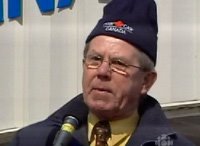 Current fish minister and deputy premier and former Premier Tom "Shakylegs" Rideout (left) is being more than a little disingenuous when he claims that he was only following the letter of the law in charging opposition politicians a bill of $400 for processing an access to information request on Rideout's travel and expense claims.
To put it bluntly, Rideout is following the standard practice of the Williams' administration to claim one thing and do something entirely different. In this instance, Rideout is claiming accountability and transparency while actively seeking to frustrate efforts to find out even the most routine of information.
In a news release today, Rideout said, among other things, that:
The Opposition chose to activate the ATIPP process. Once that process is activated, there is a legal requirement that the individuals requesting the information be charged for the work required. That is the law, and we must follow it.There's a word for this and the word is bullshit. Had they asked for it in any way except under the Act, they would be lucky to see a single paperclip. If this administration was so intent on following the law, then it would never have engaged in the pathetic Ruelokke fiasco using every second-rate legal dodge in the book to try and keep a man out of a job he had won fair and square.
For those who may not know, I served for seven years as a political aide in the administration that ended Rideout's mercifully short tenure in the Premier's Office. Contrary to his practice and that of his predecessor, we undertook to respond to access to information requests without using the fee schedule as a way of frustrating or blocking people seeking access to what is public information.
We followed the intent of the law.
Expense and travel claims were a popular request and it fell to me to co-ordinate the replies.
We did.
Without charge.
Promptly.
The fee schedule for information access requests is not an absolute requirement that must be ruthlessly applied in all cases. It is there to cover some complex requests - expense claims are not complex by any means no matter how much Rideout's nose has to grow as he tries to say otherwise.
What is more, Rideout has the ability - given his position - to waive any fees and simply hand over the documents.
It is that simple.
And what is more Rideout knows that the comments contained in the news release are merely another way of trying to hide things that otherwise can and should be in the public domain. The information can be retrieved relatively easily and without the elaborate and painful process Rideout claims it to be.
What Rideout tells us - both in his initial decision on this request and in his ludicrous defence - is that he is committed to obfuscation wherever and whenever possible. He is, in short, the embodiment of the kind of politics access to information legislation was intended to send to the rubbish tip of history.
Perhaps Rideout recalls the 1980s when Opposition access requests revealed that some of his colleagues were frequenting strip clubs and billing the "gentlemen's entertainment" to the unsuspecting family in Ming's Bight or Arnold's Cove via the public treasury.
Perhaps, he is simply following the arrogant example of the current Premier who has on more than one occasion fought tooth and nail against releasing information the release of which is specifically authorized in the legislation Rideout now uses to excuse his questionable behaviour on this access request.
No matter the reason.
Those familiar with the Williams administration in practice - as opposed to its self-massaging news releases - understand that accountability and transparency are nothing more than stock phrases to fill up the word count in already verbose news releases.
There is no meat in them any more than there is any flesh in Rideout's ability to actually implement his own policies. Bill Barry proved the severity of Rideout's impotence just this week while Rideout enjoyed gallivanting about in Norway.
Rideout is correct on one point. The current members of the Opposition did do things just as bad as he has now done when they occupied the government benches. But two wrongs do not make a right as surely Mr. Rideout knows.
To borrow one of his own malapropisms, what Rideout has shown in his flounting of the intention of the freedom of information act is that you cannot get a skunk to change its spots.
Rideout is used to saying one thing and doing another.
So too is his current boss.
Too bad Tom wasn't paying attention to the policies of the guy who replaced him, the guy who not only talked about accountability and openness but who ensured the talk was turned into action.
Too bad that Tom can only talk about it but not do it.
Too bad, that is, for the people of Newfoundland and Labrador.
Scott Simms and the fallow field of dreams
Would central Newfoundland Liberal member of parliament Scott Simms do the rest of us a favour and name a single significant oil or gas discovery offshore Newfoundland and Labrador that is being left deliberately undeveloped by any license holder?
Just one.
Please.
If you can't Scott, there really isn't any reason for your proposed private members bill, other than perhaps to act as a stalking horse for Danny Williams.
By the by, Scott b'y, if you want to get a decent background on the facts of the offshore, I can easily arrange it for you.
Just one.
Please.
If you can't Scott, there really isn't any reason for your proposed private members bill, other than perhaps to act as a stalking horse for Danny Williams.
By the by, Scott b'y, if you want to get a decent background on the facts of the offshore, I can easily arrange it for you.
Demographics, economics increase pressure on temperamental Williams and volatile policies
There are, however, some urgent domestic priorities -— the necessities of life, the outmigration of our youth, unity, mismanagement and economic diversification.
Danny Williams, Progressive Conservative leadership victory speech, April 7, 2001
That was then.
Recent data from Statistics Canada show an interesting trend now.
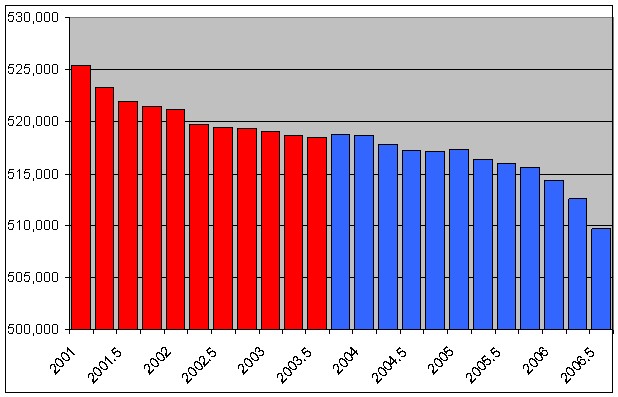 Table A (left), shows population figures for Newfoundland and Labrador from 2001 to the present in half year time periods. Note that there has been a general decline over the entire period but that the rate of decline increases after January 2005.
This likely reflects the series of economic setbacks in the fishery (FPI in particular), Stephenville, and the failure of Hebron on top of the outflow of individuals that otherwise occurs.
There is generally a flow into and out of the province each year. The figures presented in Table A reflect the net result of inflow and outflow.
 Table B (above) shows the annual rate of population change for Newfoundland and Labrador from 1952 to the present.
Green represents growth and red represents a decline in population. The largest decline is in periods after the cod moratorium.
When Danny Williams took office, the rate of population decline was on par with declines in the mid-1980s.
The rate for the first half of 2006 is the same as that experienced in the mid-1990s and in 2002.
New Approach neededOne of the overriding implications of the outmigration trends is that Danny Williams pseudo-nationalist posturing will do medium- and long-term damage to Newfoundland and Labrador.
Not only is the overall population declining, but, as forecast since the early 1990s, the population remaining will become increasingly dominated by retirees and children. The shrinking productive portion of the population means that the economy must become more productive. It also means the provincial government must have increased revenues or - at the very least - more stable sources of income.
The longer the Williams administration holds up reform of the fishery, particularly Fishery Products International, the more difficult it will be for the fishing industry to make the changes needed. Government has offered no ideas on dealing with the substantive economic problems at the heart of the current crisis; its focus on marketing is just the one aspect of the overalll issue government can without any consequence. Marketing looks good and the government doesn't risk anything politically. Unfortunately, leadership that lacks the willingness to make hard decisions is the opposite of what is needed.In the oil and gas industry, a combination of developments are demonstrating the seriousness of the Premier's miscalculation on Hebron. Development of that field would have come at exactly the right time - if a deal had been cut last spring. Despite the Premier's claims that "talks" are going on behind the scenes, the project is definitely dead and likely will be dead as long as Williams persists in his unstable, volatile mode.
A major discovery in the Gulf of Mexico by Chevron and opening of additional acreage in the Gulf also place more attractive properties in play that have far less political risk for investors, if nothing else, than dealing with the temperamental Williams administration.
Norwegian energy giant Statoil - owned 70% by the Norwegian Crown - is looking to invest CDN$1.0 billion in the Alberta tarsands, not the Newfoundland and Labrador offshore. Meanwhile, declining natural gas prices in North America make it unlikely that any interest will follow the local gas resources even if the Williams administration manages to issue a gas royalty regime by the end of the year as originally promised.
Bear in mind that Williams has sat on the regime for three years,largely ignoring it in the one-thing-after-another tedious and needless approach this government has adopted for major policy issues. As well, Williams posturing on oil and revenues suggest that Williams' gas regime would not be structured to provide competitive incentives to attract greater investment. To do otherwise would involve political risk and Williams has shown himself to fear any threat to his image.
Newfoundland and Labrador is not alone in facing dramatic demographic shifts. A group of Quebec academics and former politicians released a manifesto in 2005 that drew attention to several factors that will affect Quebec's economic and political future. One is demographic change.
While other provinces are already well on the way to addressing the impact of issues like population decline, the Williams administration seems unable to develop policies. Its approach across the board is to spout inappropriate ideas based on attitudes from the murky past.
A new approach is needed.
The only question for Newfoundlanders and Labradorians is whether the Williams administration can fundamentally change and start to deliver on its promised New Approach.
28 September 2006
Williams and The Quiet Revulsion
In a scrum with reporters before heading off to a cabinet meeting in Churchill Falls, Danny Williams couldn't help but demonstrate that fundamentally he is getting desperate.
Reporters asked him for reaction to a column in today's Globe by Konrad Yakabuski who points out, among other things that Williams' gamble on the Lower Churchill will likely end in failure. Yakabuski puts the gamble in the context of Hydro-Quebec's hydro-electric development projects that will arrive in the marketplace likely well before the Lower Churchill.
Bond Papers has discussed the same issue following on Yakabuski's last column on the subject. We've also noted that Newfoundland and Labrador Hydro is well behind the competition in developing its own project largely because Williams opted for a so-called go-it-alone option without having even put together a business plan.
That's right.
No business plan before coming to a project that would double the provincial debt.
Bear in mind that in 2001, Williams told enthusiastic provincial Tories in his leadership acceptance speech that "[m]y approach, if you give me the opportunity, will be to set out clearly our goals and to formulate a plan to get us there". This is the same Danny Williams who later committed to a $9.0 billion project without even the most cursory, the most basic, the most fundamental of business management tools.
Almost immediately after that commitment in 2001 he said:
What sound financial management?
Williams response to Yakabuski through reporters is telling. Williams said that Canadians should develop the Lower Churchill because Williams' competition - Quebec - is to volatile to rely on.
Williams has shown himself on numerous occasions to be volatile and in this instance his excuses - that is the most charitable thing to call such petty comments - are an indication of nothing more than his tendency to spit in anyone's eye if it serves his own personal political ends.
The reaction from Quebec, Ontario and from national non-government organizations, as reported by Canadian Press in the story linked above for example, is both predictable and accurate. This is not about pitting province against province.
National audiences should appreciate as well that Williams' comments on Quebec tieing up the power grid in order to exclude Labrador energy are nonsense. They are nonsensical because in Williams' own pursuit of the solo option on the Lower Churchill, he has investigated the cost of doing everything from building transmission lines to American markets to assuming the cost of upgrading the connection between Quebec and Ontario in order to move Lower Churchill power into markets other than Quebec.
He had no choice but do so. In selecting his go-it-alone option, Williams rejected a sound proposal from Ontario and Quebec that would have seen those provinces bear the costs of expanding the grid. Having decided to bear the costs of expanding the grid himself, Williams cannot moan about the supposedly limited grid. It is nonsense; it is a non-issue.
In a larger sense, though, Williams irresponsible remarks about Quebec are just another sign of the extent to which Williams quick-lip have alienated him from virtually everyone of consequence outside Newfoundland and Labrador. In 2004, he stormed out of a federal-provincial conference not because of a disagreement with Ottawa over offshore finances - as he claimed - but rather because his some of his fellow premiers were growing increasingly annoyed with his self-serving approach and his histrionics.
In successive tirades and fits of pique, Williams has created a climate in which he is viewed as unstable. The investment community has looked in amazement as Williams threatened expropriation whenever he hasn't gotten his way not once or twice but on several occasions. His recent crusade on legislation to force development of offshore oilfields is nothing more than an attempt to bring about by legal force majeure what he could not achieve or would not achieve in fair negotiations.
Williams is wrong about the need for the legislation or the issue and the more he pursues it and rants about it the stronger the message that is sent to people who might be willing to do business with him: Don't do it. Avoid Newfoundland and Labrador.
Next Tuesday, Williams' business department will finally unveil the so-called re-branding image for Newfoundland and Labrador. No matter how brilliant it is - and a great many great ideas are already said to have be quashed by Williams' veto when he ran the business portfolio himself - there is precious little a nice picture and a slick advertising campaign can do to get past the dismal reputation Williams has earned for himself after three years in office.
Isolated politically, unable to produce a successful major economic initiative and facing the resurgence of a political scandal in the House of Assembly when more detailed reports are released later this year, Williams may be the darling of the opinion polls. This is increasingly an image, though and not something of substance.
A mood is growing in Newfoundland and Labrador.
There is increasingly a sense of quiet revulsion at Williams' histrionics since ranting seems to be all he has. Since the 2005 offshore deal with Ottawa - that delivered nothing more than increased federal handouts - Williams has not been able to close a single deal. In Hebron, he gambled, miscalculated and lost billions in oil revenue.
The effects of that failure - the repeated failures - will be seen increasingly the months and years ahead. The men and women who were looking forward to developing the local oil and gas economy have already felt the sense of revulsion as they leave the province to work elsewhere. Men and women in other parts of the province - like Harbour Breton or Stephenville - have felt the revulsion. As more and more feel the sting of the failures, the revulsion will grow.
In typical Newfoundland and Labrador fashion, though, they will not throw up barricades or take to the airwaves. No. They will keep their feelings inside, voicing their anger, their discontent - or worse their profound disappointment - only to their most trusted friends. Theirs is a quiet revulsion that does not show up in government-goosed public opinion polls, but it is there. And for a government, it is acid that slowly eats away at its term of office.
Joe Smallwood held power for 22 years; Brian Peckford, a decade. Brian Tobin lasted four years and by the third year there was an increasing disquiet at his leadership.
Newfoundlanders and Labradorians have grown increasingly tired of politicians who have nothing to offer but confrontation. John Crosbie's characterization of Williams in the recent Independent issue - that he is a fighter because we love fighters - may have held the promise of long-lasting political success two decades ago.
But this place changed long before Danny Williams came to office.
This is a place where the quiet revulsion that eventually toppled Smallwood and defeated Peckford comes much more quickly than ever.
And unless Danny Williams changes to a genuinely New Approach, he will likely suffer the same fate.
Try as he might, he will have no one to blame but himself.
Reporters asked him for reaction to a column in today's Globe by Konrad Yakabuski who points out, among other things that Williams' gamble on the Lower Churchill will likely end in failure. Yakabuski puts the gamble in the context of Hydro-Quebec's hydro-electric development projects that will arrive in the marketplace likely well before the Lower Churchill.
Bond Papers has discussed the same issue following on Yakabuski's last column on the subject. We've also noted that Newfoundland and Labrador Hydro is well behind the competition in developing its own project largely because Williams opted for a so-called go-it-alone option without having even put together a business plan.
That's right.
No business plan before coming to a project that would double the provincial debt.
Bear in mind that in 2001, Williams told enthusiastic provincial Tories in his leadership acceptance speech that "[m]y approach, if you give me the opportunity, will be to set out clearly our goals and to formulate a plan to get us there". This is the same Danny Williams who later committed to a $9.0 billion project without even the most cursory, the most basic, the most fundamental of business management tools.
Almost immediately after that commitment in 2001 he said:
I realize the importance of a strategic plan and the sound financial management on which it must be based.What plan?
What sound financial management?
Williams response to Yakabuski through reporters is telling. Williams said that Canadians should develop the Lower Churchill because Williams' competition - Quebec - is to volatile to rely on.
Williams has shown himself on numerous occasions to be volatile and in this instance his excuses - that is the most charitable thing to call such petty comments - are an indication of nothing more than his tendency to spit in anyone's eye if it serves his own personal political ends.
The reaction from Quebec, Ontario and from national non-government organizations, as reported by Canadian Press in the story linked above for example, is both predictable and accurate. This is not about pitting province against province.
National audiences should appreciate as well that Williams' comments on Quebec tieing up the power grid in order to exclude Labrador energy are nonsense. They are nonsensical because in Williams' own pursuit of the solo option on the Lower Churchill, he has investigated the cost of doing everything from building transmission lines to American markets to assuming the cost of upgrading the connection between Quebec and Ontario in order to move Lower Churchill power into markets other than Quebec.
He had no choice but do so. In selecting his go-it-alone option, Williams rejected a sound proposal from Ontario and Quebec that would have seen those provinces bear the costs of expanding the grid. Having decided to bear the costs of expanding the grid himself, Williams cannot moan about the supposedly limited grid. It is nonsense; it is a non-issue.
In a larger sense, though, Williams irresponsible remarks about Quebec are just another sign of the extent to which Williams quick-lip have alienated him from virtually everyone of consequence outside Newfoundland and Labrador. In 2004, he stormed out of a federal-provincial conference not because of a disagreement with Ottawa over offshore finances - as he claimed - but rather because his some of his fellow premiers were growing increasingly annoyed with his self-serving approach and his histrionics.
In successive tirades and fits of pique, Williams has created a climate in which he is viewed as unstable. The investment community has looked in amazement as Williams threatened expropriation whenever he hasn't gotten his way not once or twice but on several occasions. His recent crusade on legislation to force development of offshore oilfields is nothing more than an attempt to bring about by legal force majeure what he could not achieve or would not achieve in fair negotiations.
Williams is wrong about the need for the legislation or the issue and the more he pursues it and rants about it the stronger the message that is sent to people who might be willing to do business with him: Don't do it. Avoid Newfoundland and Labrador.
Next Tuesday, Williams' business department will finally unveil the so-called re-branding image for Newfoundland and Labrador. No matter how brilliant it is - and a great many great ideas are already said to have be quashed by Williams' veto when he ran the business portfolio himself - there is precious little a nice picture and a slick advertising campaign can do to get past the dismal reputation Williams has earned for himself after three years in office.
Isolated politically, unable to produce a successful major economic initiative and facing the resurgence of a political scandal in the House of Assembly when more detailed reports are released later this year, Williams may be the darling of the opinion polls. This is increasingly an image, though and not something of substance.
A mood is growing in Newfoundland and Labrador.
There is increasingly a sense of quiet revulsion at Williams' histrionics since ranting seems to be all he has. Since the 2005 offshore deal with Ottawa - that delivered nothing more than increased federal handouts - Williams has not been able to close a single deal. In Hebron, he gambled, miscalculated and lost billions in oil revenue.
The effects of that failure - the repeated failures - will be seen increasingly the months and years ahead. The men and women who were looking forward to developing the local oil and gas economy have already felt the sense of revulsion as they leave the province to work elsewhere. Men and women in other parts of the province - like Harbour Breton or Stephenville - have felt the revulsion. As more and more feel the sting of the failures, the revulsion will grow.
In typical Newfoundland and Labrador fashion, though, they will not throw up barricades or take to the airwaves. No. They will keep their feelings inside, voicing their anger, their discontent - or worse their profound disappointment - only to their most trusted friends. Theirs is a quiet revulsion that does not show up in government-goosed public opinion polls, but it is there. And for a government, it is acid that slowly eats away at its term of office.
Joe Smallwood held power for 22 years; Brian Peckford, a decade. Brian Tobin lasted four years and by the third year there was an increasing disquiet at his leadership.
Newfoundlanders and Labradorians have grown increasingly tired of politicians who have nothing to offer but confrontation. John Crosbie's characterization of Williams in the recent Independent issue - that he is a fighter because we love fighters - may have held the promise of long-lasting political success two decades ago.
But this place changed long before Danny Williams came to office.
This is a place where the quiet revulsion that eventually toppled Smallwood and defeated Peckford comes much more quickly than ever.
And unless Danny Williams changes to a genuinely New Approach, he will likely suffer the same fate.
Try as he might, he will have no one to blame but himself.
The King of Id
 Danny Williams' was named leader of the Progressive Conservative Party of Newfoundland and Labrador in early 2001. His speech on that occasion contains a great many memorable quotes.
Left: Danny Williams. Not exactly as illustrated.
In the weeks ahead, we'll bring you some excerpts from it. For starters, here's the section where Williams lays out the essence of his approach.
Williams has quoted John Kennedy on several occasions although it is not clear on any of those occasions if Williams ever understood what Kennedy was talking about.
Anyway, from April 7 2001 here is Danny, in his own words:
John F. Kennedy said: "Ask not what your country can do for you but what you can do for your country."___________________
I say to Newfoundlanders and Labradorians: "Ask not what we can do for our country, because we have done enough. Let's ask our country what they can do for us."
Update: Some readers didn't quite get this. The indented section above is Danny Williams, in his own words. it is a full and accurate quote.
It doesn't make sense, said one e-mailer.
Of course not.
That's the point for people who understand Kennedy's clarion call to public service and selflessness in striving for a larger good.
But if you understand the constant messages from Williams that we have been stupid victims - until electing Danny - and that Newfoundlanders and Labradorians are collectively entitled to hand-outs, payback, reparations or compensation for supposed past injustices, then Williams' meaning becomes starkly clear.
27 September 2006
Only the brave gamble with HQ?
Konrad Yakabuski's column in the Wednesday Globe makes some worthwhile observations on Danny Williams' got-it-alone option on the Lower Churchill. If you can't get the full article using the link above, try google news and search with the words "hydro Quebec" and "konrad".
1. There is a certain correlation between the timing of the go-it-alone announcement and the no-go-at-all announcement on Hebron.
2. Williams isn't actually gambling with Hydro Quebec. He is spitting in their eye. Maybe Konrad missed the memo.
A couple of things Konrad may have missed:
Newfoundland Premier Danny Williams decided earlier this year to go it alone on a proposed $6-billion to $9-billion (according to already stale estimates) hydroelectric development on the lower Churchill River in Labrador, rejecting an offer from Hydro-Quebec and the Ontario government to jointly build the 2,800-megawatt project. It was great politics. Newfoundlanders still feel they're being stiffed by Quebec on the massive 5,400-MW Churchill Falls hydro deal that their late premier Joey Smallwood negotiated in the sixties. They'd dearly love to see their current leader stiff Quebec on the lower Churchill.
The problem is that it's impossible. Hydro-Quebec is the biggest and most savvy hydroelectric company on the continent. When Mr. Williams turned his nose up at its offer, it took about two seconds for Hydro-Quebec chief executive officer Thierry Vandal to move to Plan B. The latter entails fast-tracking 4,500-MW worth of hydro developments within Quebec. If Hydro-Quebec's stated goal is not to prevent Newfoundland from proceeding without it on the lower Churchill, its decision to green-light competing projects in la belle province certainly casts enough of a pall over Newfoundland's project in order to make it a tough sell for Mr. Williams.
1. There is a certain correlation between the timing of the go-it-alone announcement and the no-go-at-all announcement on Hebron.
2. Williams isn't actually gambling with Hydro Quebec. He is spitting in their eye. Maybe Konrad missed the memo.
Next Tuesday
Where: The Rooms.
What: Big Event.
Organized by: The Department of Business, but most likely starring the province's Chief Spitter.
Supposedly a monumental and stupendous event in the history of Newfoundland and Labrador.
(If the Spitter takes a leak, it qualifies as that to some.)
Could it be:
the branding initiative?
Finally.
At long last.
Try not to hyperventilate in anticipation.
The Spitter is said to have rejected concepts, scripts and all manner of creative effort in order to get just the right look and feel.
But we will know what the final product is next Tuesday.
At the Rooms.
Be there.
What: Big Event.
Organized by: The Department of Business, but most likely starring the province's Chief Spitter.
Supposedly a monumental and stupendous event in the history of Newfoundland and Labrador.
(If the Spitter takes a leak, it qualifies as that to some.)
Could it be:
the branding initiative?
Finally.
At long last.
Try not to hyperventilate in anticipation.
The Spitter is said to have rejected concepts, scripts and all manner of creative effort in order to get just the right look and feel.
But we will know what the final product is next Tuesday.
At the Rooms.
Be there.
Spitter Spatter
Memo
To: Ann
Subject: Your letter to the Telly, September 26, praising Danny.
1. Danny Williams, his supporters and friends are not the only people who are passionate about Newfoundland and Labrador, nor do they have a monopoly on the right passion.
2. The thing about Danny is not that he is willing to spit in the devil's eye "for us", as you put it. That's a charming image, but the way you suggest that we all love him because he is doing it "for us" puts us in a child-like status - we need someone to stand up for us - or, in an even more creepy implication, that Danny assumes some sort of Christ-like perfection because whatever he does he does "for us" and our best interests.
3. Nope, Ann. The thing about Danny is that he has shown himself lately to be willing to spit in anyone's eye just because he thinks it's the right thing to do.
4. Doesn't matter who you are. Big corporation ready to spend billions creating jobs in the province. Guy who wins a job competition fairly and squarely by the rules.
Doesn't matter.
5. If Danny takes a dislike to you, then you can expect a monster loogie inbound aimed directly at your ocular sensors.
6. Apparently, if we read Ann's letter, we don't have to wonder or worry about what he is doing. All that's important is that he is doing his cud hurling "for us." Danny gets an automatic pass on the responsibility thing. Danny's actions are blessed because they are "for us".
7. The bonus? He gets nothing out of it. No stroke of the ego even. Nope, the Selfless Wonder is apparently beyond such mortal concerns.
8. Thanks for the thought, Ann, but no thanks.
We elected a Premier, not some sort of reject from The Mystery Men.
The Shoveler.
The Bowler.
The Blue Raj.
Mr. Furious (Danny read for the part).
The Spitter. (Concept rejected in favour of a guy whose fantastic power is farting.)
The faster we stop getting letters to the editor like this latest one from Ann, the faster we might get Danny back down to Earth and putting his considerable talents into something productive.
You see, Danny might be able to spew for England, but the rest of us are starting to get hit by bigger and bigger chunks of the spatter.
Ann might like to hold Danny innocent of the consequences.
The rest of us don't have that luxury.
To: Ann
Subject: Your letter to the Telly, September 26, praising Danny.
1. Danny Williams, his supporters and friends are not the only people who are passionate about Newfoundland and Labrador, nor do they have a monopoly on the right passion.
2. The thing about Danny is not that he is willing to spit in the devil's eye "for us", as you put it. That's a charming image, but the way you suggest that we all love him because he is doing it "for us" puts us in a child-like status - we need someone to stand up for us - or, in an even more creepy implication, that Danny assumes some sort of Christ-like perfection because whatever he does he does "for us" and our best interests.
3. Nope, Ann. The thing about Danny is that he has shown himself lately to be willing to spit in anyone's eye just because he thinks it's the right thing to do.
4. Doesn't matter who you are. Big corporation ready to spend billions creating jobs in the province. Guy who wins a job competition fairly and squarely by the rules.
Doesn't matter.
5. If Danny takes a dislike to you, then you can expect a monster loogie inbound aimed directly at your ocular sensors.
6. Apparently, if we read Ann's letter, we don't have to wonder or worry about what he is doing. All that's important is that he is doing his cud hurling "for us." Danny gets an automatic pass on the responsibility thing. Danny's actions are blessed because they are "for us".
7. The bonus? He gets nothing out of it. No stroke of the ego even. Nope, the Selfless Wonder is apparently beyond such mortal concerns.
8. Thanks for the thought, Ann, but no thanks.
We elected a Premier, not some sort of reject from The Mystery Men.
The Shoveler.
The Bowler.
The Blue Raj.
Mr. Furious (Danny read for the part).
The Spitter. (Concept rejected in favour of a guy whose fantastic power is farting.)
The faster we stop getting letters to the editor like this latest one from Ann, the faster we might get Danny back down to Earth and putting his considerable talents into something productive.
You see, Danny might be able to spew for England, but the rest of us are starting to get hit by bigger and bigger chunks of the spatter.
Ann might like to hold Danny innocent of the consequences.
The rest of us don't have that luxury.
26 September 2006
The sorry truth...
is that this little piece of creative historical writing (damianpenny.com) is not far off the position taken by a great many Canadians in the 1940s.
Heck, even today there are a bunch of Canadians who are by no means Nazis who would argue we should have done exactly as the fictitious Jack Layton does in this piece.
Some people believe there is no justification for fighting at all and adopt a consistent moral position. Gandhians are philosophically and morally whole.
Then there are the ones who would condemn any use of force...by the United States. They will rationalise any situation as long as they don't have to be on the same side as the Americans. They are neither morally nor philosophically whole.
Anyway, here's just the lede of an imaginary news story from 1944, if Jack Layton had been alive at the time and running the NDP's forerunner, the CCF.
If nothing else, give a chuckle. it's pretty creative.
Heck, even today there are a bunch of Canadians who are by no means Nazis who would argue we should have done exactly as the fictitious Jack Layton does in this piece.
Some people believe there is no justification for fighting at all and adopt a consistent moral position. Gandhians are philosophically and morally whole.
Then there are the ones who would condemn any use of force...by the United States. They will rationalise any situation as long as they don't have to be on the same side as the Americans. They are neither morally nor philosophically whole.
Anyway, here's just the lede of an imaginary news story from 1944, if Jack Layton had been alive at the time and running the NDP's forerunner, the CCF.
If nothing else, give a chuckle. it's pretty creative.
Ottawa (CBP): The federal CCF leader, Mr Jack Layton, called today, in a House of Commons debate on the war situation, for Canadian troops in Western Europe to be withdrawn from combat on the front lines. "The United Nations' offensive, which has been moving forward rapidly after the breakout from Normandy, shows clear signs of stalling as Allied forces approach Germany and Holland," said Mr Layton.
The first rule of Fight Club...
is: you do not talk about Fight Club.
Unless you are one of a bunch of seriously deluded teenagers in Corner Brook.
Thankfully, they have been silly enough to appear on camera talking about the absence of violence at an event where boys and girls get together for the sport of beating the living cr** out of each other.
Go figure the logic in that one.
Now maybe police, school authorities and...wait for it... the parents involved can sort these children out before it is too late.
Unless you are one of a bunch of seriously deluded teenagers in Corner Brook.
Thankfully, they have been silly enough to appear on camera talking about the absence of violence at an event where boys and girls get together for the sport of beating the living cr** out of each other.
Go figure the logic in that one.
Now maybe police, school authorities and...wait for it... the parents involved can sort these children out before it is too late.
NL hit hard in cuts at a time of surplus
Among the program cuts that will affect Newfoundland and Labrador while the federal government announced a record-setting surplus:
- $20 million cut to DFO;
- $13.9 million in DND; and,
- $39.2 million in ACOA and related agencies for social economy programs;
The province's tourism industry will also likely be affected by the cuts to the GST rebate program for foreign visitors. The total elimination of the program will actually increase government revenues by $78 million but drive up the cost of visiting Canada.
- $20 million cut to DFO;
- $13.9 million in DND; and,
- $39.2 million in ACOA and related agencies for social economy programs;
The province's tourism industry will also likely be affected by the cuts to the GST rebate program for foreign visitors. The total elimination of the program will actually increase government revenues by $78 million but drive up the cost of visiting Canada.
CPC hypocrisy on Afghanistan
No. No.
Not the Conservative Party of Canada.
The real CPC.
The Communist Party of Canada.
Elizabeth Rowley came down to Newfoundland to explain why Canada's presence in Afghanistan is bad.
But here's the thing.
What was her position and that of her party 20 years ago when Moscow sent Soviet troops into Afghanistan in a full-blown invasion after Soviet special forces had murdered the president?
Hmmm?
Beuhler?
Beuhler?
Elizabeth might want to check the talking points she was using between 1979 and 1989. I am reasonably sure she thought that a real "dirty war" was just tickety-boo back then.
Which "dirty" wars are bad and which are good usually depends on the latest version written on the barn wall.
In a related story, provincial New Democrat leader Lorraine Michael had a hard time on CBC Radio's Morning Show trying to make a coherent point on Afghanistan. She had a prime spot - right after the Canadian ambassador to Afghanistan but just couldn't deliver a simple, clear set of points.
She talked at one point about how the Taliban weren't responsible for 9/11. Sadly, Lorraine sounded like she was defending the Taliban although I find it hard to believe that was her intention.
She spent a lot of time talking about details that were either misstated or would be irrelevant to most listeners. She raised the completely irrelevent point that the defence component of current policy - defence, diplomacy and development - costs more than the development piece. That doesn't mean development is underfunded, except in the facile world of the NDP foreign policy. It just reflects the sad fact that a grenade costs more than a sack of flour. As the security portion of the equation takes hold, those expenses can and in all likelihood will decline.
It is truly a sad state of affairs for a national Canadian party - the NDP - to be in this position, but it is a result of their lame efforts on the Afghan issue.
[Updated, and revised]
Not the Conservative Party of Canada.
The real CPC.
The Communist Party of Canada.
Elizabeth Rowley came down to Newfoundland to explain why Canada's presence in Afghanistan is bad.
But here's the thing.
What was her position and that of her party 20 years ago when Moscow sent Soviet troops into Afghanistan in a full-blown invasion after Soviet special forces had murdered the president?
Hmmm?
Beuhler?
Beuhler?
Elizabeth might want to check the talking points she was using between 1979 and 1989. I am reasonably sure she thought that a real "dirty war" was just tickety-boo back then.
Which "dirty" wars are bad and which are good usually depends on the latest version written on the barn wall.
In a related story, provincial New Democrat leader Lorraine Michael had a hard time on CBC Radio's Morning Show trying to make a coherent point on Afghanistan. She had a prime spot - right after the Canadian ambassador to Afghanistan but just couldn't deliver a simple, clear set of points.
She talked at one point about how the Taliban weren't responsible for 9/11. Sadly, Lorraine sounded like she was defending the Taliban although I find it hard to believe that was her intention.
She spent a lot of time talking about details that were either misstated or would be irrelevant to most listeners. She raised the completely irrelevent point that the defence component of current policy - defence, diplomacy and development - costs more than the development piece. That doesn't mean development is underfunded, except in the facile world of the NDP foreign policy. It just reflects the sad fact that a grenade costs more than a sack of flour. As the security portion of the equation takes hold, those expenses can and in all likelihood will decline.
It is truly a sad state of affairs for a national Canadian party - the NDP - to be in this position, but it is a result of their lame efforts on the Afghan issue.
[Updated, and revised]
DFO cuts in a time of surplus
Check nottawa to get a quick take on cuts to the Department of Fisheries and Oceans announced on Monday by the Harper administration.
The fish minister, Loyola Hearn, complained for years about DFO underfunding while he was an opposition MP.
Once he makes it to the Privy Council, Loyola's move is to slash spending in a supposedly underfunded department.
Hmmm.
Guess re-allocation never entered his head.
The fish minister, Loyola Hearn, complained for years about DFO underfunding while he was an opposition MP.
Once he makes it to the Privy Council, Loyola's move is to slash spending in a supposedly underfunded department.
Hmmm.
Guess re-allocation never entered his head.
25 September 2006
Another one joins the Dion bus
On this day when two campaigns for Liberal leader are shutting down or melting down and another is growing, comes this endorsement of Stephane Dion.
Simon Lono hasn't been holding back his support for Dion, it's just that a couple of references to Lono over the weekend in local media prompted him to state his reasons for backing Dion.
Simon Lono hasn't been holding back his support for Dion, it's just that a couple of references to Lono over the weekend in local media prompted him to state his reasons for backing Dion.
La Romaine, the Rock and the hard place
The Sunday edition of Newfoundland and Labrador's largest circulation daily newspaper, The Telegram, devoted its editorial to the implications for this province of Hydro Quebec's proposed development of the La Romaine river complex.
For some unknown reason, the editorial is not online. Instead, the Telly has reproduced a piece by one of its columnists in place of the editorial.
In any event, "It's time to talk turkey", argues that it is unconscionable that Hydro Quebec is proceeding with this project since:
1. the headwaters of the river complex are in Labrador and thus far there have been no consultations with the Government of Newfoundland and Labrador; and,
2. the La Romaine project will be a direct competitor for the Lower Churchill, should that project be developed.
Let's tackle these contentions in turn.
The border between Labrador and Quebec was established in a 1927 decision of the judicial committee of the Privy Council. The law lords concluded:
On that basis, the contention that the headwaters of the La Romaine lie inside Labrador would seem to be an error.
If the headwaters actually lie inside Labrador, then Hydro Quebec would have to consult and that would be a basis for people having some concern about the development. But that is about it. The La Romaine proposal does not cross into Labrador and the uppermost dam structure will not come closer than 10 kilometres to the general position of border between Labrador and Quebec. We can complain about not being properly advised but short of having our feelings hurt, there is not much of a claim Newfoundland and Labrador can make beyond that.
Newfoundland and Labrador would be hard pressed to justify trying to block the La Romaine project, if that is ultimately where Danny Williams winds up. All that Hydro Quebec management has done here is nothing more dastardly than showing they are smarter at business and politics than the St. John's premier. We may not like it - and certainly Danny won't - but that is hardly a crime and it would hardly be worth some kind of political or legal jihad of the losing type Williams seems to thrive on.
On the second point, though, one need only remind nervous nellies like the editorialist that it has been known for some time that demand for electricity is driving a great many developments besides the Lower Churchill.
Premier Danny Williams rushed an announcement earlier this year that he would "go it alone" on the Lower Churchill simply because the previous week Quebec had announced its own plans for further development of Quebec's own hydro potential.
Williams had a viable proposal in front of him - from Ontario and Quebec - that could have formed the basis for an eventual agreement. Instead he opted to restart the entire project from scratch and introduce delays in project sanction and construction. He did so knowing full well that other projects were moving ahead at a good pace, that Quebec had already invested in environmental studies and that Quebec was already talking to Ontario on power sales agreements. Williams' own officials arrived in Ontario well after Quebec.
In many respects, the bleating by The Telegram at this juncture is just a waste of ink and paper Williams has already laid out the course for the Lower Churchill project. The project may wind up being shelved or - worse still - it may wind up being a got-it-alone give-away of monumental proportions simply because the Premier and his advisors made yet another strategic misstep. Williams has made the bed and the Telegram's editorialist and all the other residents of the province will have to lay in it, for good or ill.
There is no small irony that the tone underneath the worrying over the Romaine project - fretting the Quebec bogeyman - was very much part of Williams' public explanation for why he chose the so-called "go it alone" option in the first place.
As Bond Papers has noted previously, though, this use of the Quebec bogeyman may serve transient political purposes for all-too-typical politicians like Williams but it actually serves to hamper the sensible, logical and orderly development of natural resources in Newfoundland and Labrador in a fashion that produces lasting benefits for the people of the province.
The Telegram is right in syaing that the time has come to "talk turkey" on Labrador hydro power. However, we should be less concerned about talking with Quebec on the La Romaine than with asking some very hard questions of our provincial government on their handling of the entire Labrador hydropower file.
For some unknown reason, the editorial is not online. Instead, the Telly has reproduced a piece by one of its columnists in place of the editorial.
In any event, "It's time to talk turkey", argues that it is unconscionable that Hydro Quebec is proceeding with this project since:
1. the headwaters of the river complex are in Labrador and thus far there have been no consultations with the Government of Newfoundland and Labrador; and,
2. the La Romaine project will be a direct competitor for the Lower Churchill, should that project be developed.
Let's tackle these contentions in turn.
The border between Labrador and Quebec was established in a 1927 decision of the judicial committee of the Privy Council. The law lords concluded:
This definition would suggest that the Romaine river complex lies inside Quebec in its entirety. Quebec maps on the border correctly describe it as being "undefined" or "not definitive". That is because the border has never been surveyed. That said, the description cited above fits the overall contention by the Privy Council decision that rivers flowing to the St. Lawrence and to the west are within Quebec, while Labrador comprises rivers flowing to the east and the Atlantic.
For the above reasons, their Lordships are of opinion that, according to the true construction of the statutes, Orders in Council, and Proclamations referred to in the Order of Reference, the boundary between Canada and Newfoundland in the Labrador Peninsula is a line drawn due north from the eastern boundary of the bay or harbour of Ance Sablon as far as the fifty-second degree of north latitude, and from thence westward along that parallel until it reaches the Romaine River, and then northward along the left or east bank of that river and its head waters to their source, and from thence due north to the crest of the watershed or height of land there, and from thence westward and northward along the crest of the watershed of the rivers flowing into the Atlantic Ocean until it reaches cape Chidley; and they will humbly advise His Majesty Accordingly.
On that basis, the contention that the headwaters of the La Romaine lie inside Labrador would seem to be an error.
If the headwaters actually lie inside Labrador, then Hydro Quebec would have to consult and that would be a basis for people having some concern about the development. But that is about it. The La Romaine proposal does not cross into Labrador and the uppermost dam structure will not come closer than 10 kilometres to the general position of border between Labrador and Quebec. We can complain about not being properly advised but short of having our feelings hurt, there is not much of a claim Newfoundland and Labrador can make beyond that.
Newfoundland and Labrador would be hard pressed to justify trying to block the La Romaine project, if that is ultimately where Danny Williams winds up. All that Hydro Quebec management has done here is nothing more dastardly than showing they are smarter at business and politics than the St. John's premier. We may not like it - and certainly Danny won't - but that is hardly a crime and it would hardly be worth some kind of political or legal jihad of the losing type Williams seems to thrive on.
On the second point, though, one need only remind nervous nellies like the editorialist that it has been known for some time that demand for electricity is driving a great many developments besides the Lower Churchill.
Premier Danny Williams rushed an announcement earlier this year that he would "go it alone" on the Lower Churchill simply because the previous week Quebec had announced its own plans for further development of Quebec's own hydro potential.
Williams had a viable proposal in front of him - from Ontario and Quebec - that could have formed the basis for an eventual agreement. Instead he opted to restart the entire project from scratch and introduce delays in project sanction and construction. He did so knowing full well that other projects were moving ahead at a good pace, that Quebec had already invested in environmental studies and that Quebec was already talking to Ontario on power sales agreements. Williams' own officials arrived in Ontario well after Quebec.
In many respects, the bleating by The Telegram at this juncture is just a waste of ink and paper Williams has already laid out the course for the Lower Churchill project. The project may wind up being shelved or - worse still - it may wind up being a got-it-alone give-away of monumental proportions simply because the Premier and his advisors made yet another strategic misstep. Williams has made the bed and the Telegram's editorialist and all the other residents of the province will have to lay in it, for good or ill.
There is no small irony that the tone underneath the worrying over the Romaine project - fretting the Quebec bogeyman - was very much part of Williams' public explanation for why he chose the so-called "go it alone" option in the first place.
As Bond Papers has noted previously, though, this use of the Quebec bogeyman may serve transient political purposes for all-too-typical politicians like Williams but it actually serves to hamper the sensible, logical and orderly development of natural resources in Newfoundland and Labrador in a fashion that produces lasting benefits for the people of the province.
The Telegram is right in syaing that the time has come to "talk turkey" on Labrador hydro power. However, we should be less concerned about talking with Quebec on the La Romaine than with asking some very hard questions of our provincial government on their handling of the entire Labrador hydropower file.
24 September 2006
he spoke. and rapidly drank a glass of water.
Scanning back through the Bond Papers, I noticed I had neglected to post a version of a column I wrote for the Independent the week after Danny Williams' January 5, 2004 speech in which he announced government spending cutbacks, public sector layoffs and a two year wage freeze.
Now three years later some of the observations made at the time seem so relevant that it is appropriate to reprint the original column. For those who may not be familiar with it, the title is a line from "Next to of course God America I", a poem by e.e. cummings that satirizes the vacuous rhetoric of American politicians and the gullibility of those who believe it.
The five or six government communications people who cobbled the thing together with Danny himself actually had the phrase "short term pain for long term gain" in the drafts, apparently right up to the end. Only then did someone realize the line - lifted directly from John Crosbie's federal budget speech in December 1979 - was just a bit too familiar. They changed it to "short-term pain in return for long-term meaningful benefits." While that line got changed, Williams' affection for clusters of words devoid of meaning has only grown with time.
For some reason, Williams had neglected to produce the customary holiday messages from the Premier in 2004 so he began this speech with belated greetings and then proceeded to tell everyone the arse was supposedly out of 'er. The contrast between the giddy heights of optimism he had conjured during the election and and the depths of despair he engendered in this one speech - and how the whole policy came about - affected the operations of government for the next year or so. It was a bad speech, matched by a horrendous delivery.
As we have already noted, the shock to Williams' own ego from the subsequent drop in polling numbers led him to abandon entirely and unequivocally everything he committed to in this speech, except for the wage freezes. Once cash started rolling in though, Williams even delivered a modest salary increase beyond the ones negotiated at the back end of the public sector deals just ensure people forgot his January fiasco in 2004.
It may seem like the Williams' first speech was delivered a century ago, but it was not quite three years ago. Political trivia buffs will recall that in one interview after the speech, Williams referred to the authors of the financial report as PriceClubWaterhouseCoopers.
For your light, Sunday reading enjoyment here is a column originally published in early January 2004.
Outside the box:
he spoke. And rapidly drank a glass of water.
In his tribute to American poet e.e. cummings, Premier Danny Williams only said one thing we had not heard before: there will be no public sector wage increases for the next several years.
There were no other surprises in what the Premier said. All PriceWaterhouseCoopers did for their $100, 000 was take the 2003 budget, add forecasts from government officials and reprint them. The deficit now and in the future is too large to maintain and something must be done about it. They did remind us that, unlike the 1990s when the provincial economy was in deep recession, government will consistently have more money in the coming years. Add Voisey'’s Bay and increased oil exploration and things get better still. In other words, action is needed, but it doesn'’t have to be the drastic action forced on government by international circumstances a decade and more ago. Why the Premier chose to freeze wages and portray a difficult situation as desperate is the question to be answered.
Any competent public relations professional will tell you that communications are judged not by the telling but by the doing.
Maybe there is some half-baked strategy that by re-creating the situation in 1933, the federal government will pour money into the province. Don'’t count on it for a whole bunch of reasons, not the least of which is that the facts make it clear that we are not now, nor are we likely to be bankrupt.
What the Premier did last week, though, was demonstrate that his government has not yet figured out what it is going to do. It appeared that in all the talk about "“growing the economy"” with a New Approach, capitalization is more than an innovative use of the shift key. Apparently not.
What the Premier also did was send the provincial economy into a downturn, despite knowing from government officials that strong consumer confidence has been a key part of government'’s income to date and will continue to be. With a handful of words, he made the province'’s deficit bigger and therefore worsened the situation he already claimed was shocking and beyond belief. That claim is nonsense.
By some accounts, the Premier also showed us that he is prepared to bypass his caucus and his cabinet in announcing the wage freeze. Just as he kept the Blue Book a secret from his party until the second it was made public, he apparently kept the wage freeze a closely guarded secret as well. One suspects that Loyola Sullivan has not been able to give even the most basic details of the freeze not because of cabinet confidence, but because the Premier hasn'’t told him yet what they are.
It's bad enough that cabinet may not yet have reached a decision on how it plans to deal with the province'’s financial situation. We simply don't know why Danny Williams made his announcement this week in the way he did. If the Premier indeed made a unilateral decree on wage freezes - a decree - – then that is a problem looming within the government with implications for us all that are indeed shocking and beyond belief.
The odd thing about public relations is that the more you say something without doing it, the less you will be believed. Count the number times Loyola Sullivan and the Premier insisted last week that they are being straight with people, laying out the facts, being open, honest and accountable.
Count how many times they said they have a plan.
Now three years later some of the observations made at the time seem so relevant that it is appropriate to reprint the original column. For those who may not be familiar with it, the title is a line from "Next to of course God America I", a poem by e.e. cummings that satirizes the vacuous rhetoric of American politicians and the gullibility of those who believe it.
next to of course god america iWilliams' speech was a masterpiece of cliche and hollow phrasing built around an assessment by government finances that was, to put it mildly, a feast of invention and make-believe. More accurately, one might call it a crock, a load or indeed just a flat-out pile of nonsense at least as far as its dismal projections for revenues were concerned.
love you land of the pilgrims' and so forth oh
say can you see by the dawn's early my
country 'tis of centuries come and go
and are no more what of it we should worry
in every language even deafanddumb
thy sons acclaim your glorious name by gorry
by jingo by gee by gosh by gum
why talk of beauty what could be more beaut-
iful than these heroic happy dead
who rushed like lions to the roaring slaughter
they did not stop to think they died instead
then shall the voice of liberty be mute?"
He spoke. And drank rapidly a glass of water
The five or six government communications people who cobbled the thing together with Danny himself actually had the phrase "short term pain for long term gain" in the drafts, apparently right up to the end. Only then did someone realize the line - lifted directly from John Crosbie's federal budget speech in December 1979 - was just a bit too familiar. They changed it to "short-term pain in return for long-term meaningful benefits." While that line got changed, Williams' affection for clusters of words devoid of meaning has only grown with time.
For some reason, Williams had neglected to produce the customary holiday messages from the Premier in 2004 so he began this speech with belated greetings and then proceeded to tell everyone the arse was supposedly out of 'er. The contrast between the giddy heights of optimism he had conjured during the election and and the depths of despair he engendered in this one speech - and how the whole policy came about - affected the operations of government for the next year or so. It was a bad speech, matched by a horrendous delivery.
As we have already noted, the shock to Williams' own ego from the subsequent drop in polling numbers led him to abandon entirely and unequivocally everything he committed to in this speech, except for the wage freezes. Once cash started rolling in though, Williams even delivered a modest salary increase beyond the ones negotiated at the back end of the public sector deals just ensure people forgot his January fiasco in 2004.
It may seem like the Williams' first speech was delivered a century ago, but it was not quite three years ago. Political trivia buffs will recall that in one interview after the speech, Williams referred to the authors of the financial report as PriceClubWaterhouseCoopers.
For your light, Sunday reading enjoyment here is a column originally published in early January 2004.
Outside the box:
he spoke. And rapidly drank a glass of water.
In his tribute to American poet e.e. cummings, Premier Danny Williams only said one thing we had not heard before: there will be no public sector wage increases for the next several years.
There were no other surprises in what the Premier said. All PriceWaterhouseCoopers did for their $100, 000 was take the 2003 budget, add forecasts from government officials and reprint them. The deficit now and in the future is too large to maintain and something must be done about it. They did remind us that, unlike the 1990s when the provincial economy was in deep recession, government will consistently have more money in the coming years. Add Voisey'’s Bay and increased oil exploration and things get better still. In other words, action is needed, but it doesn'’t have to be the drastic action forced on government by international circumstances a decade and more ago. Why the Premier chose to freeze wages and portray a difficult situation as desperate is the question to be answered.
Any competent public relations professional will tell you that communications are judged not by the telling but by the doing.
Maybe there is some half-baked strategy that by re-creating the situation in 1933, the federal government will pour money into the province. Don'’t count on it for a whole bunch of reasons, not the least of which is that the facts make it clear that we are not now, nor are we likely to be bankrupt.
What the Premier did last week, though, was demonstrate that his government has not yet figured out what it is going to do. It appeared that in all the talk about "“growing the economy"” with a New Approach, capitalization is more than an innovative use of the shift key. Apparently not.
What the Premier also did was send the provincial economy into a downturn, despite knowing from government officials that strong consumer confidence has been a key part of government'’s income to date and will continue to be. With a handful of words, he made the province'’s deficit bigger and therefore worsened the situation he already claimed was shocking and beyond belief. That claim is nonsense.
By some accounts, the Premier also showed us that he is prepared to bypass his caucus and his cabinet in announcing the wage freeze. Just as he kept the Blue Book a secret from his party until the second it was made public, he apparently kept the wage freeze a closely guarded secret as well. One suspects that Loyola Sullivan has not been able to give even the most basic details of the freeze not because of cabinet confidence, but because the Premier hasn'’t told him yet what they are.
It's bad enough that cabinet may not yet have reached a decision on how it plans to deal with the province'’s financial situation. We simply don't know why Danny Williams made his announcement this week in the way he did. If the Premier indeed made a unilateral decree on wage freezes - a decree - – then that is a problem looming within the government with implications for us all that are indeed shocking and beyond belief.
The odd thing about public relations is that the more you say something without doing it, the less you will be believed. Count the number times Loyola Sullivan and the Premier insisted last week that they are being straight with people, laying out the facts, being open, honest and accountable.
Count how many times they said they have a plan.
Subscribe to:
Posts (Atom)