VOCM ran one of their on-line questions of the day o Thursday asking people if they felt the province's flag should be changed to the Pink, White and Green.
Now a poll like this sure isn't scientific, but as they go, supporters of a cause like the PWG will normally try to stack the results in their favour. Certainly with the amount of comment on VO's talk radio programs, one would think that if any crowd would support the old native flag, this would be it.
Not so.
64% voted against changing the provincial flag. 27% supported a change, while 9% were not sure.
14 October 2005
13 October 2005
Expert consultant tackles St. John's sewer problems
 St. John's city council calls in expert to tackle its water and sewer woes.
[We wish!]
"A sewer worker is like a brain surgeon. We're both specialists."
- Ed Norton


Colonial Building - further thoughts
A series of unusual e-mails yesterday prompted some further digging into the management plan for the Colonial Building, as discussed in Our plastic history. That digging prompted some further consideration of the issues and the plan.
There should be no question as to the Colonial Buildings historic importance as the former seat of government for Newfoundland and Labrador and, as a result, being the setting for some of the most important events in the history of Newfoundland and Labrador and of Canada.
Nor should there be any question of the need to restore and preserve the Colonial Building as a public building.
The only issue is the purpose to which the building should be put.
Some may suggest it be an historic site maintained much like Commissariat House either by the provincial government or the federal government or both.
The provincial government's management plan will see it turned into offices for one small section of a provincial government department plus its associated non-government groups.
Given its historic significance, the Colonial Building should become once again the meeting place of the House of Assembly.
Here are some additional thoughts:
1. A surplus legislature.There is something bordering on the bizarre about the idea of having a legislature building in a functioning democracy that is somehow surplus to requirements and in need of a management plan.
That's one of the ideas in Our plastic history and it remains probably the most powerful reaction I have to the management plan.
Try as I might, I haven't been able to identify another example from the Commonwealth where this situation exists. There have been several examples of legislature buildings in the United States being replaced by new structures. There is one in Oregon, for example. There's also one in Illinois and in Boston. There are also old legislature buildings in Rhode Island and Connecticut.
It seems these legislature buildings were replaced by new ones owing to the need for larger space which the existing buildings and their surrounding land couldn't provide. That's a pretty simple and practical reason. In Boston, the Old State House became Boston City Hall for a period and until it was purchased and restored the building was the site of shops and restaurants.
In Oregon, the Old Capitol is still a government office building. In Illinois and Massachusetts, the old legislature buildings have been restored and maintained solely as historic sites.
In Newfoundland and Labrador, the Colonial Building served as home to both the House of Assembly and the Legislative Council until suspension of responsible government in 1933/34. During the Commission Government period, it served as government offices. The National Convention met in the House of Assembly chamber from 1946 to 1948 to consider the future constitution of the country and from Confederation in 1949 to 1959, the provincial legislature sat there.
Moving the House of Assembly from the Colonial Building to the newly built Confederation Building seems to have had more to do with the preferences of Premier Joe Smallwood than on any space problems or any technical shortcomings with the old building. [I am open to correction on this point if someone has better information.]
2. Was there a committee? After some checking with some people involved and after listening to John Fitzgerald's interview on CBC Radio this morning, I have come to the conclusion that there was and there wasn't a committee.
There was no committee in the sense that a group of people were given a defined mandate by the Williams administration or its predecessor.
What did exist was the group of people listed on page 30 of the management plan, chaired by former minister of education Dr. Phil Warren. They examined options, looked at cost estimates, reviewed the issues involved in the different options and worked to find some consensus among the group on what ought to be done with the Colonial Building.
With the change of administration in October 2003, it appears that group (which I'd still call a committee) fell apart with the bulk of the subsequent work being handled by an out-of-province consultant, Dr. John Weiler.
3. Is the plan the same as what this group discussed? Being neither privy to the options discussed nor to the deliberations of the group, I can only judge based on John Fitzgerald's comments to CBC Radio.
Essentially, he argues that the final plan reflects the direction in which the committee was moving. That's my paraphrase of his remarks but I am satisfied they are accurate.
4. What will the Colonial Building be? Essentially, under the management plan, the Colonial Building will become offices for the Provincial Historic Sites program and for upwards of eight not-for-profit groups.
That will be the major function of the building the goes on day-in and day-out.
Some other events will take place there from time to time, such as youth parliament, investiture ceremonies, receptions and potentially wedding photographs.
There will also be a fairly pricey "interpretation" program for the Building so that people can become somewhat familiar with the history of it.
That said, the day-to-day function of the building will be office space, primarily for not-for-profits. The presence of the one government section (Historic Sites) would justify the costs of restoring and rehabilitating the site as well as the ongoing maintenance and security work that would need to be done.
5. What will it cost? Craig Welsh, over at Townie Bastard questioned the cost of relocating the House of Assembly to the Colonial Building.
Fair enough. I took the government estimates at face value since they represented, supposedly, the cost of bring the Building up to current occupancy standards and addressing the accessibility issues in an old building. Based on what I had in mind, I couldn't see the total cost heading for much more than the proposed $3.0 million or so. It might hit $5.0 million, but there is more than enough cash in the province's budget now or over the next couple of years to fund that amount. Bear in mind that The Rooms as a new facility with significant archaeological issues cost about $40 million. Refurbishing the Colonial Building should not come even close to 25% of that figure; it would be far less than $10 million.
As for the management plan, I can't comment on the cost estimates for the structural section. The "interpretation" bit, which came to $850,000 seemed a bit rich, as in over-priced. It should be possible to produce a much more effective set of interpretive materials without spending the kind of cash involved here, at least on some items.
Someone suggested to me that the cost estimates might be lowballed. I don't know but that is one suggestion I am working to track down.
6. Not-for-profits: are they treated equally? The provincial government does provide support for some not-for-profit groups. However, while there is some internally consistent logic in the management plan of locating the historic sites section with associated not-for-profit non-government groups, there is a question as to whether government should be assisting some groups and not assisting others of equal importance to the delivery of government services to a comparable degree.
There is likely a much better way to support not-for-profits than allowing them to use the Colonial Building.
7. Putting the House of Assembly in the Colonial Building would be too inconvenient. Two advantages of turning the Colonial Building back into the local parliament would be that maintenance, security and upkeep as wells interpretation and all the other bits would come out of the House of Assembly budget allocation. If we moved the Speaker's Office, the Clerk, house committees, the sergeant-at-arms, ushers, television and audio service and the Library to the Building, we would have a functioning legislature. A small adjunct building would not drive the costs up dramatically, but it is something to consider.
Undoubtedly, there are people who would talk about the inconvenience of moving from the Hill to the Building.
It happens in other places. The offices for elected members as well as the government administration offices are frequently in buildings different from the legislature.
Parking can be accommodated by revamping the existing grounds and looking across the street to the Government House grounds.
Undoubtedly, some people will talk about the things to be lost - like the size of the public gallery.
Ok. That's a good point, but in fact, the existing galleries are massive in relation to the usual public traffic during a session. The most frequent visitors to the galleries are political staff and comms directors. They can give up their seats to voters and other visitors and still carry out their function somewhere else like an adjoining room with a television feed.
Quite a bit of functionality for staff was lost in the move to the current location for the House, for example. The loss was largely one of habit and convenience and staff rapidly found new ways to do what they needed to do. Expect the same at the Colonial Building.
Size of the assembly shouldn't be an issue. There are currently 48 elected members of the House of Assembly. That is only slightly larger than the size of the National Convention and the early post-Confederation legislatures. In the current location, the amount of space taken up by the elected members has grown to meet the huge space in which they meet. There is a great deal of unused space both on the floor of the legislature and in the public galleries.

If anyone still wants to quibble, just bear in mind that at Westminster [see picture at left] only about a third to a half of the elected members of the House of Common can actually sit on benches - they have never had desks of the type seen in Canadian legislatures. During crucial votes, members crowd about with some sitting and most standing.
With the legislature returned to the Colonial Building, the Legislative Council chamber could easily function as both a House committee meeting room as well as the site for investitures and other provincial or national ceremonies. It is a large, well-laid-out room with public galleries for observers.
8. Restoring the House of Assembly to the old chamber would destroy the historic character of the Colonial Building. The Colonial Building as it stands today is not the original structure erected in the middle of the 19th century, nor is it the building that was converted to an archives space in the 1960s. Interior and exterior changes occurred on several occasions as documented in the management plan.
Any decision on restoration will fix the building at a particular point in time and may not adequately represent the entire history of the building when it was in daily use as a legislative complex.
Restoration of the House of Assembly to the Colonial Building would allow the structure to be altered only to meet current occupancy code requirements, while at the same time preserving as many of the essential elements of the interior structure as is practicable and consistent with the Building's designation as an historic site.
Returning the provincial legislature to the Colonial Building would also mitigate against some time when a future government strapped for cash or a department no longer interested in sustaining the Colonial Building looks to close it or skimps on maintenance.
A site of such evident importance should not be left to suffer potentially the same fate as the Old Military Hospital.
9. The Colonial Building should be a National Historic Site. With the exception of Province House in Prince Edward Island, the Colonial Building is the only national legislative building which is intimately connected to Confederation. Newfoundland and Labrador is the only country to have voted to become part of Canada. While other legislatures debated Confederation, Newfoundland and Labrador is the only existing province in which a national convention was used as the means to determine the country's constitutional fate.
The Colonial Building is a site of historical importance to Canada as a whole.
As such, an integral part of the management plan for the Colonial Building should include designation of the building as a National Historic Site. This designation would provide both the financial and technical support of the Government of Canada to assist in the proper restoration of the Colonial Building. While this could be done no matter what the building is ultimately used for, it could be extremely important in funding its use as the House of Assembly.
There should be no question as to the Colonial Buildings historic importance as the former seat of government for Newfoundland and Labrador and, as a result, being the setting for some of the most important events in the history of Newfoundland and Labrador and of Canada.
Nor should there be any question of the need to restore and preserve the Colonial Building as a public building.
The only issue is the purpose to which the building should be put.
Some may suggest it be an historic site maintained much like Commissariat House either by the provincial government or the federal government or both.
The provincial government's management plan will see it turned into offices for one small section of a provincial government department plus its associated non-government groups.
Given its historic significance, the Colonial Building should become once again the meeting place of the House of Assembly.
Here are some additional thoughts:
1. A surplus legislature.There is something bordering on the bizarre about the idea of having a legislature building in a functioning democracy that is somehow surplus to requirements and in need of a management plan.
That's one of the ideas in Our plastic history and it remains probably the most powerful reaction I have to the management plan.
Try as I might, I haven't been able to identify another example from the Commonwealth where this situation exists. There have been several examples of legislature buildings in the United States being replaced by new structures. There is one in Oregon, for example. There's also one in Illinois and in Boston. There are also old legislature buildings in Rhode Island and Connecticut.
It seems these legislature buildings were replaced by new ones owing to the need for larger space which the existing buildings and their surrounding land couldn't provide. That's a pretty simple and practical reason. In Boston, the Old State House became Boston City Hall for a period and until it was purchased and restored the building was the site of shops and restaurants.
In Oregon, the Old Capitol is still a government office building. In Illinois and Massachusetts, the old legislature buildings have been restored and maintained solely as historic sites.
In Newfoundland and Labrador, the Colonial Building served as home to both the House of Assembly and the Legislative Council until suspension of responsible government in 1933/34. During the Commission Government period, it served as government offices. The National Convention met in the House of Assembly chamber from 1946 to 1948 to consider the future constitution of the country and from Confederation in 1949 to 1959, the provincial legislature sat there.
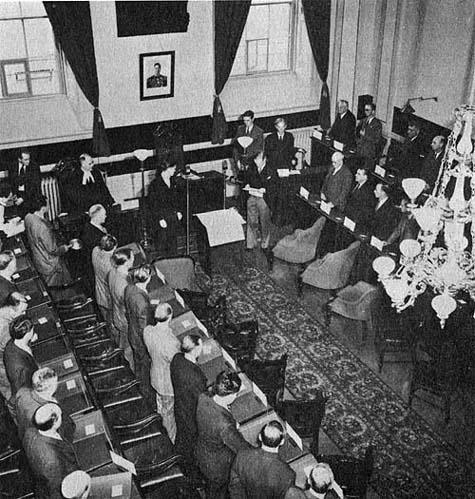
First session of the National Convention, 1946
Moving the House of Assembly from the Colonial Building to the newly built Confederation Building seems to have had more to do with the preferences of Premier Joe Smallwood than on any space problems or any technical shortcomings with the old building. [I am open to correction on this point if someone has better information.]
2. Was there a committee? After some checking with some people involved and after listening to John Fitzgerald's interview on CBC Radio this morning, I have come to the conclusion that there was and there wasn't a committee.
There was no committee in the sense that a group of people were given a defined mandate by the Williams administration or its predecessor.
What did exist was the group of people listed on page 30 of the management plan, chaired by former minister of education Dr. Phil Warren. They examined options, looked at cost estimates, reviewed the issues involved in the different options and worked to find some consensus among the group on what ought to be done with the Colonial Building.
With the change of administration in October 2003, it appears that group (which I'd still call a committee) fell apart with the bulk of the subsequent work being handled by an out-of-province consultant, Dr. John Weiler.
3. Is the plan the same as what this group discussed? Being neither privy to the options discussed nor to the deliberations of the group, I can only judge based on John Fitzgerald's comments to CBC Radio.
Essentially, he argues that the final plan reflects the direction in which the committee was moving. That's my paraphrase of his remarks but I am satisfied they are accurate.
4. What will the Colonial Building be? Essentially, under the management plan, the Colonial Building will become offices for the Provincial Historic Sites program and for upwards of eight not-for-profit groups.
That will be the major function of the building the goes on day-in and day-out.
Some other events will take place there from time to time, such as youth parliament, investiture ceremonies, receptions and potentially wedding photographs.
There will also be a fairly pricey "interpretation" program for the Building so that people can become somewhat familiar with the history of it.
That said, the day-to-day function of the building will be office space, primarily for not-for-profits. The presence of the one government section (Historic Sites) would justify the costs of restoring and rehabilitating the site as well as the ongoing maintenance and security work that would need to be done.
5. What will it cost? Craig Welsh, over at Townie Bastard questioned the cost of relocating the House of Assembly to the Colonial Building.
Fair enough. I took the government estimates at face value since they represented, supposedly, the cost of bring the Building up to current occupancy standards and addressing the accessibility issues in an old building. Based on what I had in mind, I couldn't see the total cost heading for much more than the proposed $3.0 million or so. It might hit $5.0 million, but there is more than enough cash in the province's budget now or over the next couple of years to fund that amount. Bear in mind that The Rooms as a new facility with significant archaeological issues cost about $40 million. Refurbishing the Colonial Building should not come even close to 25% of that figure; it would be far less than $10 million.
As for the management plan, I can't comment on the cost estimates for the structural section. The "interpretation" bit, which came to $850,000 seemed a bit rich, as in over-priced. It should be possible to produce a much more effective set of interpretive materials without spending the kind of cash involved here, at least on some items.
Someone suggested to me that the cost estimates might be lowballed. I don't know but that is one suggestion I am working to track down.
6. Not-for-profits: are they treated equally? The provincial government does provide support for some not-for-profit groups. However, while there is some internally consistent logic in the management plan of locating the historic sites section with associated not-for-profit non-government groups, there is a question as to whether government should be assisting some groups and not assisting others of equal importance to the delivery of government services to a comparable degree.
There is likely a much better way to support not-for-profits than allowing them to use the Colonial Building.
7. Putting the House of Assembly in the Colonial Building would be too inconvenient. Two advantages of turning the Colonial Building back into the local parliament would be that maintenance, security and upkeep as wells interpretation and all the other bits would come out of the House of Assembly budget allocation. If we moved the Speaker's Office, the Clerk, house committees, the sergeant-at-arms, ushers, television and audio service and the Library to the Building, we would have a functioning legislature. A small adjunct building would not drive the costs up dramatically, but it is something to consider.
Undoubtedly, there are people who would talk about the inconvenience of moving from the Hill to the Building.
It happens in other places. The offices for elected members as well as the government administration offices are frequently in buildings different from the legislature.
Parking can be accommodated by revamping the existing grounds and looking across the street to the Government House grounds.
Undoubtedly, some people will talk about the things to be lost - like the size of the public gallery.
Ok. That's a good point, but in fact, the existing galleries are massive in relation to the usual public traffic during a session. The most frequent visitors to the galleries are political staff and comms directors. They can give up their seats to voters and other visitors and still carry out their function somewhere else like an adjoining room with a television feed.
Quite a bit of functionality for staff was lost in the move to the current location for the House, for example. The loss was largely one of habit and convenience and staff rapidly found new ways to do what they needed to do. Expect the same at the Colonial Building.
Size of the assembly shouldn't be an issue. There are currently 48 elected members of the House of Assembly. That is only slightly larger than the size of the National Convention and the early post-Confederation legislatures. In the current location, the amount of space taken up by the elected members has grown to meet the huge space in which they meet. There is a great deal of unused space both on the floor of the legislature and in the public galleries.
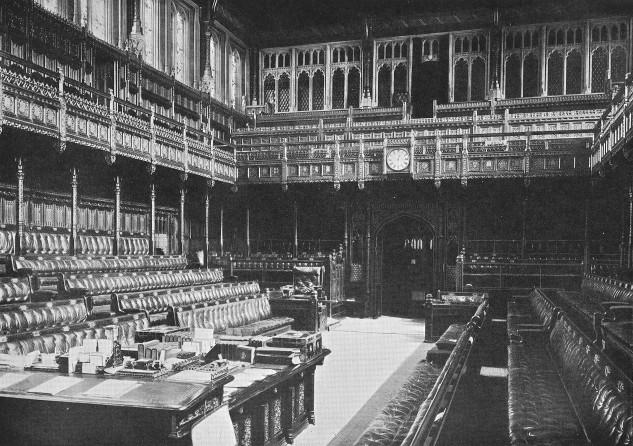
If anyone still wants to quibble, just bear in mind that at Westminster [see picture at left] only about a third to a half of the elected members of the House of Common can actually sit on benches - they have never had desks of the type seen in Canadian legislatures. During crucial votes, members crowd about with some sitting and most standing.
With the legislature returned to the Colonial Building, the Legislative Council chamber could easily function as both a House committee meeting room as well as the site for investitures and other provincial or national ceremonies. It is a large, well-laid-out room with public galleries for observers.
8. Restoring the House of Assembly to the old chamber would destroy the historic character of the Colonial Building. The Colonial Building as it stands today is not the original structure erected in the middle of the 19th century, nor is it the building that was converted to an archives space in the 1960s. Interior and exterior changes occurred on several occasions as documented in the management plan.
Any decision on restoration will fix the building at a particular point in time and may not adequately represent the entire history of the building when it was in daily use as a legislative complex.
Restoration of the House of Assembly to the Colonial Building would allow the structure to be altered only to meet current occupancy code requirements, while at the same time preserving as many of the essential elements of the interior structure as is practicable and consistent with the Building's designation as an historic site.
Returning the provincial legislature to the Colonial Building would also mitigate against some time when a future government strapped for cash or a department no longer interested in sustaining the Colonial Building looks to close it or skimps on maintenance.
A site of such evident importance should not be left to suffer potentially the same fate as the Old Military Hospital.
9. The Colonial Building should be a National Historic Site. With the exception of Province House in Prince Edward Island, the Colonial Building is the only national legislative building which is intimately connected to Confederation. Newfoundland and Labrador is the only country to have voted to become part of Canada. While other legislatures debated Confederation, Newfoundland and Labrador is the only existing province in which a national convention was used as the means to determine the country's constitutional fate.
The Colonial Building is a site of historical importance to Canada as a whole.
As such, an integral part of the management plan for the Colonial Building should include designation of the building as a National Historic Site. This designation would provide both the financial and technical support of the Government of Canada to assist in the proper restoration of the Colonial Building. While this could be done no matter what the building is ultimately used for, it could be extremely important in funding its use as the House of Assembly.
Hire George Murphy
The feds are creating an office to monitor gas prices.
The province's office is a mess.
Simple solution: hire George Murphy. The St. John's cab driver was a mere tenth of a cent off in his latest forecast for gasoline prices. That's typical of his analytical prowess.
As a bonus he is personable and does a decent interview. You can actually understand what he is talking about.
The province's office is a mess.
Simple solution: hire George Murphy. The St. John's cab driver was a mere tenth of a cent off in his latest forecast for gasoline prices. That's typical of his analytical prowess.
As a bonus he is personable and does a decent interview. You can actually understand what he is talking about.
12 October 2005
Our plastic history
For those who have visited capital cities anywhere in the western world, one is struck by the lengths to which nations go to preserve the visible symbols of their democracies.
 United States Capitol
Washington D.C.
As this site notes, the Capitol Building in Washington D.C. is one of the most important symbolic and architectural buildings in the United States. The building was destroyed by fire in 1814, but rebuilt on the same site. As the American government grew in size, the building was expanded to accommodate senators and representatives from the new states. The Capitol is an integral part of the architecture of the city of Washington, reflecting geographically the constitutional division of powers among the legislative (Capitol), executive (White House/Old Executive Office Building) and judiciary (Supreme Court).
The United States Capitol, like the House of Parliament at Westminster or the Parliament Buildings in Ottawa are much more than symbols. They are the home of elected legislatures. They are living elements of the political, social, economic and cultural life of their countries. One can stand in the very halls where some of the most important national and international decisions were debated and decided and where new issues of equal importance are considered.
Return now to Newfoundland and Labrador from this sojourn among the Great Nations and one is struck by the management plan for the Colonial Building, released last week by the provincial government's Department of Tourism, Culture and Recreation.
The plan is striking for its ability to reduce the significance of our historic seat of government to yet another mouldering artifact of the past. The language of this discussion paper is sterile: "The Colonial Building is one of the most significant heritage properties in Newfoundland and Labrador." It is said to have heritage character-defining elements.
The plan is also striking since a committee of government-appointed experts from government and the local arts, cultural and heritage associations has determined the fate of the building, now vacant with the absorption of the Provincial Archives of Newfoundland and Labrador into the bland collective known simply as The Rooms.
The Colonial Building is to be restored in some fashion and turned into offices for arts, cultural and heritage organizations in the province. There will be the obligatory charade of "stakeholder consultations", but the Colonial Building will continue to be what it has been since 1959 - home to yet another group of technocrats.
 Colonial Building circa 1949
St. John's Newfoundland and Labrador
The management plan contains many references to the political history of Newfoundland and Labrador as well as the physical alterations to the building since it was built in the 1850s. The picture above shows the two German field howitzers (150 cm calibre) installed in the 1920s for example. They were part of an extensive collection of war booty that symbolized, in part, the sacrifices made by the Dominion of Newfoundland during the Great War.
In the 1950s, these howitzers were removed, a fountain installed in their place and the guns turned over to Branch 1 of the Royal Canadian Legion. They sat untended apart from the odd splash of paint behind a hedge until one of them was unceremoniously chopped to pieces and shipped of to Robin Hood Bay. Only by the quick action of a couple of local aficionados was the only such howitzer in Canada saved from a similar fate underneath a decomposing pile of scraps from Sobeys and Dominion.
Our history is often treated with the same sense that it is disposable or plastic.
Witness the legislature itself.
Once the home of elected government in Newfoundland and Labrador, the Colonial Building was abandoned in 1959 in favour of a new site for the House of Assembly on the upper stories of Joe Smallwood's Confederation edifice. That legislature space fell victim to concerns about safety and security. The Peckford administration started the move to its current site within the Confederation Building, replete with Turkish brothel interior design.
One may stand in the same place where Winston Churchill delivered some of the most stirring speeches during the fight against Nazi tyranny or where his predecessor Benjamin Disraeli helped built Britain into a global power. One may see the very spot where Roosevelt, Lincoln or Kennedy delivered their inaugural addresses or annual state of the union speeches.
Find the spot where Joe Smallwood introduced the Come by Chance refinery bills. Seek out the spot where the Meech Lake Accord was debated. They are gone, turned into work cubicles from Dilbert or public washrooms.
The management plan for the Colonial Building comes at an estimated cost of over $3.0 million. Only $120, 000 is required for annual operations. Nearly a million dollars will go to developing an exhibit and iinterpretation program, including a hideously overpriced "audio" tour and an equally expensive "virtual tour" on the internet. A brochure will set government back about $25, 000 while the combined price for interpretation "planning" alone will exceed $70, 000. The physical restoration of the Building will be over $2.0 million.
And for what purpose? So that the very same committees that sat in judgment of the building can have luxurious places in which to remove their gaiters. So that youth parliament can continue to meet there or that investiture ceremonies can take place in the former Legislative Council chamber or that "small weddings" may lease the building for some purpose.
At the same time that some people are spending precious energy to promote their peculiar piece of fabric for a flag, one of the most important foci of our province's history is to be turned into a slightly more grand set of offices for appointed officials.
What a sad comment on the true state of our sense of national pride.
Scrap the management plan.
Restore life to the Colonial Building by making it, once again, the home of our elected legislature. The financial cost would be about the same as the management plan's estimate.
More importantly, we would avoid for one of the few times in our recent history the cost of making our collective history something to be reshaped based on nothing more than the interests of those appointed to make a decision.
 United States Capitol
Washington D.C.
As this site notes, the Capitol Building in Washington D.C. is one of the most important symbolic and architectural buildings in the United States. The building was destroyed by fire in 1814, but rebuilt on the same site. As the American government grew in size, the building was expanded to accommodate senators and representatives from the new states. The Capitol is an integral part of the architecture of the city of Washington, reflecting geographically the constitutional division of powers among the legislative (Capitol), executive (White House/Old Executive Office Building) and judiciary (Supreme Court).
The United States Capitol, like the House of Parliament at Westminster or the Parliament Buildings in Ottawa are much more than symbols. They are the home of elected legislatures. They are living elements of the political, social, economic and cultural life of their countries. One can stand in the very halls where some of the most important national and international decisions were debated and decided and where new issues of equal importance are considered.
Return now to Newfoundland and Labrador from this sojourn among the Great Nations and one is struck by the management plan for the Colonial Building, released last week by the provincial government's Department of Tourism, Culture and Recreation.
The plan is striking for its ability to reduce the significance of our historic seat of government to yet another mouldering artifact of the past. The language of this discussion paper is sterile: "The Colonial Building is one of the most significant heritage properties in Newfoundland and Labrador." It is said to have heritage character-defining elements.
The plan is also striking since a committee of government-appointed experts from government and the local arts, cultural and heritage associations has determined the fate of the building, now vacant with the absorption of the Provincial Archives of Newfoundland and Labrador into the bland collective known simply as The Rooms.
The Colonial Building is to be restored in some fashion and turned into offices for arts, cultural and heritage organizations in the province. There will be the obligatory charade of "stakeholder consultations", but the Colonial Building will continue to be what it has been since 1959 - home to yet another group of technocrats.
 Colonial Building circa 1949
St. John's Newfoundland and Labrador
The management plan contains many references to the political history of Newfoundland and Labrador as well as the physical alterations to the building since it was built in the 1850s. The picture above shows the two German field howitzers (150 cm calibre) installed in the 1920s for example. They were part of an extensive collection of war booty that symbolized, in part, the sacrifices made by the Dominion of Newfoundland during the Great War.
In the 1950s, these howitzers were removed, a fountain installed in their place and the guns turned over to Branch 1 of the Royal Canadian Legion. They sat untended apart from the odd splash of paint behind a hedge until one of them was unceremoniously chopped to pieces and shipped of to Robin Hood Bay. Only by the quick action of a couple of local aficionados was the only such howitzer in Canada saved from a similar fate underneath a decomposing pile of scraps from Sobeys and Dominion.
Our history is often treated with the same sense that it is disposable or plastic.
Witness the legislature itself.
Once the home of elected government in Newfoundland and Labrador, the Colonial Building was abandoned in 1959 in favour of a new site for the House of Assembly on the upper stories of Joe Smallwood's Confederation edifice. That legislature space fell victim to concerns about safety and security. The Peckford administration started the move to its current site within the Confederation Building, replete with Turkish brothel interior design.
One may stand in the same place where Winston Churchill delivered some of the most stirring speeches during the fight against Nazi tyranny or where his predecessor Benjamin Disraeli helped built Britain into a global power. One may see the very spot where Roosevelt, Lincoln or Kennedy delivered their inaugural addresses or annual state of the union speeches.
Find the spot where Joe Smallwood introduced the Come by Chance refinery bills. Seek out the spot where the Meech Lake Accord was debated. They are gone, turned into work cubicles from Dilbert or public washrooms.
The management plan for the Colonial Building comes at an estimated cost of over $3.0 million. Only $120, 000 is required for annual operations. Nearly a million dollars will go to developing an exhibit and iinterpretation program, including a hideously overpriced "audio" tour and an equally expensive "virtual tour" on the internet. A brochure will set government back about $25, 000 while the combined price for interpretation "planning" alone will exceed $70, 000. The physical restoration of the Building will be over $2.0 million.
And for what purpose? So that the very same committees that sat in judgment of the building can have luxurious places in which to remove their gaiters. So that youth parliament can continue to meet there or that investiture ceremonies can take place in the former Legislative Council chamber or that "small weddings" may lease the building for some purpose.
At the same time that some people are spending precious energy to promote their peculiar piece of fabric for a flag, one of the most important foci of our province's history is to be turned into a slightly more grand set of offices for appointed officials.
What a sad comment on the true state of our sense of national pride.
Scrap the management plan.
Restore life to the Colonial Building by making it, once again, the home of our elected legislature. The financial cost would be about the same as the management plan's estimate.
More importantly, we would avoid for one of the few times in our recent history the cost of making our collective history something to be reshaped based on nothing more than the interests of those appointed to make a decision.
Colonial Building Riot
 In the photo at left, thousands of Newfoundlanders and Labradorians rush to the Colonial Building to see the historic seat of government turned into offices for arts, cultural and heritage organizations.
They were heard chanting "Long Live Cubicles" and "More filing cabinets".
Police stood by as the rioters peacefully increased their awareness of the heritage defining characteristics of the achitecturally significant structure.
During the demonstration, one man in the crowd noted the absence of the lantern from the top of the building, missing since shortly after it was opened in the 1850s.
"Let us spend $125, 000 to build and install a new replica lantern," shouted the man to a smattering of applause. "Some poor architectural student needs a new grant."
11 October 2005
Local shipyards may win navy contract - amended
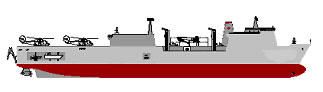
Joint Support Ship
[Provisional drawing, copyright Department of National Defence]
According to Canadian Press, two of four bidders for a contract to build supply and support ships for the Canadian navy plan to use Marystown Shipyard and other small facilities to build subcomponents of the ships. Final assembly would take place at Bull Arm.
The ships are officially known as Joint Support Ships. Anticipated delivery of the first of the three vessels is 2012, with initial operating capability (IOC) achieved in 2013.
A third bidder, SNC Lavalin would build the ships in Victoria, British Columbia. A consortium headed by General Dynamics would use the Davie yards at Lauzon Quebec.
The last time the Canadian navy under took a major ship construction, the contract was split between yards in English Canada and two yards in Quebec. The resulting mess cost the Mulroney government hundreds of millions of dollars in cost over-runs for the Halifax-class frigates.
Expect a repeat of the split process or the award of the contract to General Dynamics. The Davie yards have extensive experience in building Canadian warships.
Construction of the vessels on these timelines may impact on planned local construction of a small gravity-based structure for the Hebron-Ben Nevis project. There has been no public disclosure of how the companies involved would handle both major contracts simultaneously.
10 October 2005
Norm Doyle - some curious thoughts
The Spindy recycled a story this week about the St. John's airport authority looking to attract more "military tourist" traffic to the local airport.
What they mean is that the airport wants to see if it can attract more refueling business to the capital city's newly renovated airport.
On the face of it, this has got to be the most ludicrous idea imaginable. The military traffic through the airport is based on international conditions. The only way we can boost traffic is by having another war break out somewhere.
The airport's logic sounds nice. But the more you think about it the more you realize these guys are just off base. Some consultant is making a fortune figuring out the "decision factors" that go into bringing American aircraft here versus somewhere else.
Some clues:
1. There must be an overseas deployment, either an operation or an exercise. They need a reason to fly across the Atlantic.
2. The aircraft must be a type that cannot fly across the Atlantic without refueling. Big visitors were C-130 Hercules variants and DC-9 variants.
Beyond that, the presence of a vibrant nightlife and decent hotels meet just about all the requirements.
The Americans will be concerned somewhat about the relative cost of the Canadian dollar and high fuel prices, but basically fuel is a given - they need it. The Americans might try and find ways to double-up their travel, but as long as there are troops in Iraq, the Americans will fly through St. John's to get there.
Which brings us to the comments of St. John's North Connie member of parliament Norman Doyle.
Seems Doyle is thrilled with all the business coming to his riding, but he has some qualms about the source of the lucre.
As Normie told The Spindy: "I would certainly not support helping aircraft to service the war in Iraq because that would be the same as involving Canada in the war in Iraq."
Norm, Norm, Norm.
Canada has already supported the American campaign in Iraq directly and indirectly, including sending our own troops there as part of American and British units.
This military traffic has been going on for years.
The only way we could satisfy Norm's moral qualms would be to ban American military equipment and people from Canada.
Just think about Norm's comments logically; that's the implication.
Has Norm been having late night dinners with the New Democrats of Carolyn Parrish?
What they mean is that the airport wants to see if it can attract more refueling business to the capital city's newly renovated airport.
On the face of it, this has got to be the most ludicrous idea imaginable. The military traffic through the airport is based on international conditions. The only way we can boost traffic is by having another war break out somewhere.
The airport's logic sounds nice. But the more you think about it the more you realize these guys are just off base. Some consultant is making a fortune figuring out the "decision factors" that go into bringing American aircraft here versus somewhere else.
Some clues:
1. There must be an overseas deployment, either an operation or an exercise. They need a reason to fly across the Atlantic.
2. The aircraft must be a type that cannot fly across the Atlantic without refueling. Big visitors were C-130 Hercules variants and DC-9 variants.
Beyond that, the presence of a vibrant nightlife and decent hotels meet just about all the requirements.
The Americans will be concerned somewhat about the relative cost of the Canadian dollar and high fuel prices, but basically fuel is a given - they need it. The Americans might try and find ways to double-up their travel, but as long as there are troops in Iraq, the Americans will fly through St. John's to get there.
Which brings us to the comments of St. John's North Connie member of parliament Norman Doyle.
Seems Doyle is thrilled with all the business coming to his riding, but he has some qualms about the source of the lucre.
As Normie told The Spindy: "I would certainly not support helping aircraft to service the war in Iraq because that would be the same as involving Canada in the war in Iraq."
Norm, Norm, Norm.
Canada has already supported the American campaign in Iraq directly and indirectly, including sending our own troops there as part of American and British units.
This military traffic has been going on for years.
The only way we could satisfy Norm's moral qualms would be to ban American military equipment and people from Canada.
Just think about Norm's comments logically; that's the implication.
Has Norm been having late night dinners with the New Democrats of Carolyn Parrish?
Whither Harper?
Predictably, the relatively small rise of the federal Conservative Party in some recent polls has been enough for Connie bloggers to trumpet the results as proof of something.
The guy responsible for the supposed Connie rise in popularity is usually held out to be none other than former Chretien cabinet minister and notorious porker David Dingwall. Here's one such post from someone who finds it strange that I have called his blog Reflexive Grit-Loather Productions. Go figure.
RGL points to a Pollara poll, as reported in the NationalPost Lampoon, which shows a six point gap between the federal Liberals and the Conservatives led by Stephen Harper. The Pollara research report isn't on their website - something that always makes me suspicious - but here is a link to the Canadian Press story on the poll which gives more detail than the Lampoon story.
As well, for the sake of comparison, here are the results of a poll taken by Decima, one of their competitors.
Some observations:
1. It's pretty sad when you have to point to a dead politician from another party as the reason why your own popularity is going up. As I have noted here before about other politicians - notably the Liberal Party of Newfoundland and Labrador - the worst position to be in is the one where your fortunes are linked to the cock-ups of The Other Guy.
The people who say they are supporting you today will not be supporting you tomorrow, if the other guy doesn't screw up.
2. Don't get mislead by headlines: the polls don't show any substantive change in voter attitudes. Say what you will, the Liberals are still running about 10 to 12 points ahead of the Connies, the Pollara poll notwithstanding. If you look at the CP story, you'll see that Pollara stills has the Libs running ahead of the Connies by about the same margin as the last Pollara poll. That's no change, boys and girls.
This CP story is a non-story.
and...
3. All polls show the Liberals way ahead of the Connies in Ontario. The majority of seats come from Ontario. Ya gotta win big here to win big everywhere.
So far the Connies just aren't doing it.
Just as they haven't been doing it there for months.
4. The ads had no apparent impact. Remember those glossy ads everyone was talking about two months ago? No? Gee, I wonder why. Maybe they just missed the mark.
All of this leads us inevitably back to wondering about the future of Connie leader Steve Harper.
My guess is that the Connies will just struggle through until after the Liberals get re-elected in the spring.
Then they'll boot Harper back to Alberta and poke somebody else in Stornoway and start planning a serious political campaign.
The guy responsible for the supposed Connie rise in popularity is usually held out to be none other than former Chretien cabinet minister and notorious porker David Dingwall. Here's one such post from someone who finds it strange that I have called his blog Reflexive Grit-Loather Productions. Go figure.
RGL points to a Pollara poll, as reported in the National
As well, for the sake of comparison, here are the results of a poll taken by Decima, one of their competitors.
Some observations:
1. It's pretty sad when you have to point to a dead politician from another party as the reason why your own popularity is going up. As I have noted here before about other politicians - notably the Liberal Party of Newfoundland and Labrador - the worst position to be in is the one where your fortunes are linked to the cock-ups of The Other Guy.
The people who say they are supporting you today will not be supporting you tomorrow, if the other guy doesn't screw up.
2. Don't get mislead by headlines: the polls don't show any substantive change in voter attitudes. Say what you will, the Liberals are still running about 10 to 12 points ahead of the Connies, the Pollara poll notwithstanding. If you look at the CP story, you'll see that Pollara stills has the Libs running ahead of the Connies by about the same margin as the last Pollara poll. That's no change, boys and girls.
This CP story is a non-story.
and...
3. All polls show the Liberals way ahead of the Connies in Ontario. The majority of seats come from Ontario. Ya gotta win big here to win big everywhere.
So far the Connies just aren't doing it.
Just as they haven't been doing it there for months.
4. The ads had no apparent impact. Remember those glossy ads everyone was talking about two months ago? No? Gee, I wonder why. Maybe they just missed the mark.
All of this leads us inevitably back to wondering about the future of Connie leader Steve Harper.
My guess is that the Connies will just struggle through until after the Liberals get re-elected in the spring.
Then they'll boot Harper back to Alberta and poke somebody else in Stornoway and start planning a serious political campaign.
08 October 2005

Sun reporters might make good frag vests
The Ottawa Sun is to Ottawa what The Independent would like to be to St. John's.
Those radio spots the Spindy is running on VOCM (at $145 a pop, mind you) are sheer crap. If the newspaper was actually as informative and thought provoking as the spots claim, then I wouldn't be listening to a bunch of (likely) Dobbin employees badly reading a prepared script that tells me the paper is "informative" and that if I don't read it I must out of the loop.
If any of the claims were true, they'd be able to cite specific examples.
They can't.
People know they can't.
Therefore the spots are crap.
The Spindy is on the verge of folding.
But I digress.
Back to the Sun chain.
Take a look at this story [via Bourque]. Seems the feds have gotten a bunch of bigwigs together to take a trip to Afghanistan next week as a combination morale booster for the troops/familiarization trip for the bigwigs.
The Sun claims the trip is top secret.
How in the freep can it be secret, let alone TOP secret if some twit from The Sun is plastering everything short of the departure time on the friggin internet?
These guys should have just sent an e-mail to Al Queda so that the terrorists could blow up Canadians. This is an example of reporting at its worst. These sort of affairs are usually kept under wraps so the bad guys can't score a big propaganda coup by blowing everyone up. If The Sun wanted to expose some sort of political angle to the story - DO IT AFTER THE TRIP IS OVER AND PEOPLE ARE HOME SAFE AND SOUND.
Personally, I think, the organizers of the trip should issue every person traveling one Sun reporter as their own personal flak bait/frag vest. Let the Sun staff pay the price for the Sun's irresponsibility.
Those radio spots the Spindy is running on VOCM (at $145 a pop, mind you) are sheer crap. If the newspaper was actually as informative and thought provoking as the spots claim, then I wouldn't be listening to a bunch of (likely) Dobbin employees badly reading a prepared script that tells me the paper is "informative" and that if I don't read it I must out of the loop.
If any of the claims were true, they'd be able to cite specific examples.
They can't.
People know they can't.
Therefore the spots are crap.
The Spindy is on the verge of folding.
But I digress.
Back to the Sun chain.
Take a look at this story [via Bourque]. Seems the feds have gotten a bunch of bigwigs together to take a trip to Afghanistan next week as a combination morale booster for the troops/familiarization trip for the bigwigs.
The Sun claims the trip is top secret.
How in the freep can it be secret, let alone TOP secret if some twit from The Sun is plastering everything short of the departure time on the friggin internet?
These guys should have just sent an e-mail to Al Queda so that the terrorists could blow up Canadians. This is an example of reporting at its worst. These sort of affairs are usually kept under wraps so the bad guys can't score a big propaganda coup by blowing everyone up. If The Sun wanted to expose some sort of political angle to the story - DO IT AFTER THE TRIP IS OVER AND PEOPLE ARE HOME SAFE AND SOUND.
Personally, I think, the organizers of the trip should issue every person traveling one Sun reporter as their own personal flak bait/frag vest. Let the Sun staff pay the price for the Sun's irresponsibility.
07 October 2005
My buddy, the nitwit
 Verrryyyy interestink....but it doesn't make any sense.
This from our Glorious Boor, Andy Wells, mayor of the ancient and until recently, relatively pleasant city of St. John's:
"There was one little nitwit running around, showing up at water main breaks saying the city was going to hell in a handbasket.
Either he didn't know the difference, which is somewhat more forgivable than if he knew the difference and chose to ignore it. But the fact is we've spent substantial money on infrastructure."
For those who may have missed it, Wells was referring to Simon Lono. In case you missed it, flip over and check out Lono's campaign website, the video on city infrastructure and some of the other stuff the newbie candidate raised in his first run at municipal elected office.
There are a couple of observations to make about The Boor's attack on Lono.
1. Of all the outsider candidates, Lono obviously made a huge impression on Wells. He lost the election but Lono ranks up there with people like Shannie Duff, the former mayor, former member of the House of Assembly and current at large councillor for the ability to poke right at the Boor and get his attention.
2. As noted here previously, Wells is obviously at odds not only with Lono but also with the Board of Trade, to whom he was speaking. The Board also thinks that the municipal infrastructure deficit - lack of adequate spending on water, sewer, sidewalks and roads - is one of the major issues facing the city.
3. Wells misses the point, again. The issue isn't that the city hasn't spent money of infrastructure. Nope. Lono and the Board of Trade note that work has been done.
What they say is that there isn't enough being done.
Lono made the point that the city has been spending money propping up failed ventures like the Mile One crowd ($3.0 million annually), while at the same time sidewalks are cracking and people are being injured as a result. (Pick up The Telly today to see a front page story on two more people who suffered serious injuries due to crumbling sidewalks.)
In the Great Geyser, Lono just drew media attention to a problem that had toddled along for a week before finally erupting into a 15 foot high spout of gushing city water. The problem lay in the ancient pipes and valves in that part of the city, which were 50 years old and needing replacement when Wells first sat his Boor-ass in a council chair. They are now over 80 years old and in need of replacement and upgrading.
Yet, Wells persists in spreading the fable that everything with the water, streets and sidewalks is just ticketyboo in the City of Legends.
4. Wells intends on making the problem worse. In another part of the speech to the Board of Trade, Wells mused about tax cuts.
Ok. That sounds nice.
But if, as the Board contends, the city needs to spend more money on infrastructure, Wells' tax cuts would actually mean the city has less to spend on fixing the problems with the city streets, water and sidewalks.
Wells mentioned the federal money for infrastructure and here's where city residents should notice the shell game. Wells plans to take the federal money, which should be extra, and then use that to fund a tax cut for the city. He can do that because the city economy is booming - something Wells takes credit for but which he had nothing to do with generating. We can thank Chevron, ExxonMobil, PetroCanada, Husky, Brian Peckford for that...anybody but Wells.. 'cause they actually produced the economic boost.
Wells ought to be spending what he has committed now plus what the feds would add so we can get ahead of the game now that times are good.
Instead, Wells is actually speculating about spending no more than he is currently allowing to fix a problem everyone sees but him. Trust me: in the speech, Wells sucked and blew at the same time, deriding the idea of an infrastructure problem and then talking about putting cash into fixing it.
The result? The infrastructure will continue to fall apart and some future council led by some future mayor will have to jack up taxes and suck cash out of my pocket - maybe when the economy isn't doing so well - to pay for Andy's folly.
That ain't ticketyboo.
5. Wells' personal attacks prove another Lono point. Calling people names is old hat for The Boor. The guy seems to have some pathological need to hurl personal abuse at people he disagrees with or who disagree with him. Councillors, city staff, candidates, ordinary citizens. All are treated with contempt.
That's why Lono introduced a Code of Conduct for council when he launched his election campaign.
It would have committed council to being open, transparent, and in this type of thing, being grown-up about how city business gets done.
Wells's abusive style may amuse some. Truth is it belittles the people on the receiving end of his abuse. It belittles Wells himself. But worse, it belittles the residents of the city.
On both counts, the people of St. John's deserve better.
But, in closing, just go back and read Wells' own comments and then apply them to the mayor himself:
"Either he didn't know the difference, which is somewhat more forgivable than if he knew the difference and chose to ignore it."
It is pretty clear that Wells knows the difference about the infrastructure problem. Heck he's been on council since the Moores administration.
Yet, he chooses to ignore it.
You be the judge.
Personally, I'll be standing firmly behind my good buddy, the nitwit.
He ain't going away Andy.

Zis is not good, here. I am not killing you. Don't you understand? You must die. Will you cooperate?!!
Lawyers and blogs: a good start
Try this article from the New York Times on the unusual number of lawyers and judges who either maintain blog sites or who read them.
A few lawyers and judges read this little collection of e-scribbles. Why, I have no idea.
Blogging is one use of the Internet that I think performs a useful function. It contributes, with any luck and a lot of hope, to the wider discussion of ideas and trends affecting our society.
Lawyers, who once dominated politics in Western countries, have slipped from their prominence in that field: sadly, in some cases; thankfully in others. Generally, lawyers have add to a debate both in the style and the substance of their arguments.
There are exceptions to every rule, of course.
A few lawyers and judges read this little collection of e-scribbles. Why, I have no idea.
Blogging is one use of the Internet that I think performs a useful function. It contributes, with any luck and a lot of hope, to the wider discussion of ideas and trends affecting our society.
Lawyers, who once dominated politics in Western countries, have slipped from their prominence in that field: sadly, in some cases; thankfully in others. Generally, lawyers have add to a debate both in the style and the substance of their arguments.
There are exceptions to every rule, of course.
Who really twisted arms, Steve?
As predicted here, the Royal Newfoundland Constabulary came up empty in their investigation of alleged witness tampering in the trial of the poor guy charged with beating the crap out of Danny Boy Junior.
Williams' lawyer, Steve Marshall claims that someone's arm was twisted to get stories changed. Steve, maybe we should wonder who did the arm twisting to get the original "eyewitness" testimony into play in the first place. Marshall's entire claim of tampering was, of course, without any foundation. He was just blowin' smoke, maybe, just maybe in an effort to get people off the scent of his former law partner. Seems the Prem did some early morning phone calls to the Constab which Marshall subsequently explained with a bullshit excuse.
Maybe, just maybe, the RNC should release the tapes of the Prem's calls to the office so we can finally put the whole arm-twisting thing to bed.
Oh yeah.
and Steve owes the accused in this case an apology.
So does Danny, who claims the accused assailant had a political motive in the beating.
No evidence of that either, at all, ever.
Yet another horsecrap conspiracy theory from our own low-rent Fox Mulder.
Williams' lawyer, Steve Marshall claims that someone's arm was twisted to get stories changed. Steve, maybe we should wonder who did the arm twisting to get the original "eyewitness" testimony into play in the first place. Marshall's entire claim of tampering was, of course, without any foundation. He was just blowin' smoke, maybe, just maybe in an effort to get people off the scent of his former law partner. Seems the Prem did some early morning phone calls to the Constab which Marshall subsequently explained with a bullshit excuse.
Maybe, just maybe, the RNC should release the tapes of the Prem's calls to the office so we can finally put the whole arm-twisting thing to bed.
Oh yeah.
and Steve owes the accused in this case an apology.
So does Danny, who claims the accused assailant had a political motive in the beating.
No evidence of that either, at all, ever.
Yet another horsecrap conspiracy theory from our own low-rent Fox Mulder.
NOIA recycles the offshore
How many times will NOIA focus on Hebron and gas development as part of "new" possibilities for the offshore?
I lost count of how many times NOIA ran a seminar like this one under Leslie Galway. Now that she has been replaced by someone the NOIA board figured is tight with Dean MacDonald and hence Danny Boy, NOIA is back at the same old crap again.
Three things:
1. NOIA is oriented in the wrong direction and is yet again strategically snookered if it thinks hiring someone who knows someone who knows Danny will get them on the Premier's radar screen. Hint: He doesn't give a flying derrick about NOIA.
2. Hebron - being held up by the guy NOIA is trying to suck up to. Problem - NOIA can't suck up to Danny on the one side and then try to blow him slightly off his position on the other. All sucking got the last time was a job for Leslie Galway. NOIA needs to start being professional about their government relations and dispose of the amateur crap.
3. Note the speaker for the event is Ed Martin, the guy who has been slowly transforming Newfoundland and Labrador Hydro into PetroNewf without so much as a public discussion of what the frig he is up to. When exactly will Danny and his Boys decide the public deserves to know what they are doing with our money? When will we find out why two vice presidents and some senior managers were tossed over the Falls recently and who is replacing them?
Second point from this: Ed's on the agenda 'cause of Dean (the chairman of Ed's board), who of course is connected to the new NOIA president, who was hired for being able to make just those kinds of daisy chains, with Danny at the front end of it. (That's just in case you missed the high-end strategic thinking I noted earlier.)
When exactly will a NOIA session on "new" things actually include something new?
I lost count of how many times NOIA ran a seminar like this one under Leslie Galway. Now that she has been replaced by someone the NOIA board figured is tight with Dean MacDonald and hence Danny Boy, NOIA is back at the same old crap again.
Three things:
1. NOIA is oriented in the wrong direction and is yet again strategically snookered if it thinks hiring someone who knows someone who knows Danny will get them on the Premier's radar screen. Hint: He doesn't give a flying derrick about NOIA.
2. Hebron - being held up by the guy NOIA is trying to suck up to. Problem - NOIA can't suck up to Danny on the one side and then try to blow him slightly off his position on the other. All sucking got the last time was a job for Leslie Galway. NOIA needs to start being professional about their government relations and dispose of the amateur crap.
3. Note the speaker for the event is Ed Martin, the guy who has been slowly transforming Newfoundland and Labrador Hydro into PetroNewf without so much as a public discussion of what the frig he is up to. When exactly will Danny and his Boys decide the public deserves to know what they are doing with our money? When will we find out why two vice presidents and some senior managers were tossed over the Falls recently and who is replacing them?
Second point from this: Ed's on the agenda 'cause of Dean (the chairman of Ed's board), who of course is connected to the new NOIA president, who was hired for being able to make just those kinds of daisy chains, with Danny at the front end of it. (That's just in case you missed the high-end strategic thinking I noted earlier.)
When exactly will a NOIA session on "new" things actually include something new?
06 October 2005
Tough aircraft. Tougher pilot.

Flip over to Strange Military and you'll find the full size version of these pictures.
They show the starboard rear section of an American A-10A ground attack aircraft shot up by small arms fire. The hits and the chunk taken out of the horizontal stabilizer apparently knocked out the aircraft hydraulics. That means the pilot landed without brakes and with limited controls.
The A-10 is designed to take hits by bigger things than the rifles that appear to have shot up this particular aircraft. It's almost 30 years old and isn't loved by a lot of American pilots who like the faster and supposedly sexier stuff.
Tough, dependable, does the job and gets the pilot back in one piece.
Works for me.
S*P*I*E*S Like Us
Six immigrants trying to enter the country illegally?
Or people trying to enter the country under assumed identities to act as spies?
You decide.
Six people from mainland China were arrested for trying to enter Canada at St. John's with Korean identity documents.
It seems a little expensive and convoluted for an immigration scheme.
It sounds more like an old, tested way of getting spies into a foreign country. The Soviets were famous for the approach and planted several hundred such spies in Canada during the Cold War. In the case of Chinese, they could easily pass as Koreans.
As for Connie member of parliament Loyola Hearn's claim this is proof of the lax security at our harbours, one can only scratch one's head in bewilderment. Surely Loyola understands that the people involved were caught. They were identified and arrested based on intelligence analysis and co-operation among different security agencies.
No one in the country is well served by Mr. Hearn and his colleagues making claims about the supposedly unsecured ports of entry at our harbours when this simply isn't the case. Security may not be perfect, but then again even in the United States today illegal immigrants and foreign spies and terrorists are able to enter.
All Loyola Hearn is doing with his comments is feeding uninformed comment and raising more questions among our American allies about Canadian security that simply aren't well-founded. While Hillary Clinton is busily trying to stop a proposal that all travelers to the United States will need to carry passports, Hearn is fueling the sort of diatribes we hear from Faux News and other right-wing outfits. Clinton has correctly pointed to the disastrous effects the new policy will have on trade.
Hearn is just giving Rush Limbaugh and Bill O'Reilly more ammunition.
Way to go, Loyola.
Or people trying to enter the country under assumed identities to act as spies?
You decide.
Six people from mainland China were arrested for trying to enter Canada at St. John's with Korean identity documents.
It seems a little expensive and convoluted for an immigration scheme.
It sounds more like an old, tested way of getting spies into a foreign country. The Soviets were famous for the approach and planted several hundred such spies in Canada during the Cold War. In the case of Chinese, they could easily pass as Koreans.
As for Connie member of parliament Loyola Hearn's claim this is proof of the lax security at our harbours, one can only scratch one's head in bewilderment. Surely Loyola understands that the people involved were caught. They were identified and arrested based on intelligence analysis and co-operation among different security agencies.
No one in the country is well served by Mr. Hearn and his colleagues making claims about the supposedly unsecured ports of entry at our harbours when this simply isn't the case. Security may not be perfect, but then again even in the United States today illegal immigrants and foreign spies and terrorists are able to enter.
All Loyola Hearn is doing with his comments is feeding uninformed comment and raising more questions among our American allies about Canadian security that simply aren't well-founded. While Hillary Clinton is busily trying to stop a proposal that all travelers to the United States will need to carry passports, Hearn is fueling the sort of diatribes we hear from Faux News and other right-wing outfits. Clinton has correctly pointed to the disastrous effects the new policy will have on trade.
Hearn is just giving Rush Limbaugh and Bill O'Reilly more ammunition.
Way to go, Loyola.
05 October 2005
Is City Hall for sale?
The Montreal Gazette just finished a three-part story on problems in Montreal's municipal campaign financing.
Here's the editorial that concludes the series.
Here's the bit that started it all.
Anyone care to try looking at St. John's municipal campaign expenses and contributions by donors?
Good luck.
Under the provincial law, only winning candidates have to report any donations of cash over $100. Anything given "in-kind" is never reported - it doesn't have to be.
So... anyone with a private company or two can hide an unlimited amount of campaign work as an "in-kind" contribution. Need a few thousand signs? No problem, says the supporter. My company can supply them and my volunteers will put them up for you.
That's a possibility not that it actually happened. It may have happened and certainly you'll hear plenty of anecdotal information - some of it pure spec and rumour - about who did what for whom.
The problem is that residents of St. John's have no way of knowing what is being given and spent by whom and for whom in city politics.
If nothing else - at the very least - the whole lack of accountability creates a cloud of suspicion that doesn't improve the image of politics in local eyes.
In the worst case, city residents can be concerned that the millions of dollars in municipal contracts and the millions of dollars of development in the city might be had for a few bucks at election time.
Better that we fix the election expense laws and bring more information into the public domain rather than endure suspicion that ultimately erodes public confidence in the electoral system.
Here's the editorial that concludes the series.
Here's the bit that started it all.
Anyone care to try looking at St. John's municipal campaign expenses and contributions by donors?
Good luck.
Under the provincial law, only winning candidates have to report any donations of cash over $100. Anything given "in-kind" is never reported - it doesn't have to be.
So... anyone with a private company or two can hide an unlimited amount of campaign work as an "in-kind" contribution. Need a few thousand signs? No problem, says the supporter. My company can supply them and my volunteers will put them up for you.
That's a possibility not that it actually happened. It may have happened and certainly you'll hear plenty of anecdotal information - some of it pure spec and rumour - about who did what for whom.
The problem is that residents of St. John's have no way of knowing what is being given and spent by whom and for whom in city politics.
If nothing else - at the very least - the whole lack of accountability creates a cloud of suspicion that doesn't improve the image of politics in local eyes.
In the worst case, city residents can be concerned that the millions of dollars in municipal contracts and the millions of dollars of development in the city might be had for a few bucks at election time.
Better that we fix the election expense laws and bring more information into the public domain rather than endure suspicion that ultimately erodes public confidence in the electoral system.
04 October 2005
Today in Newfoundland and Labrador History
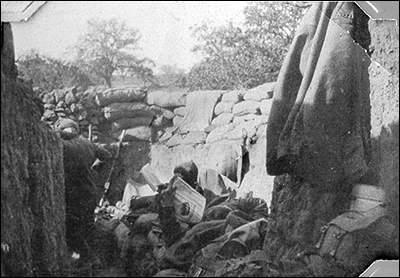 Trenches at Suvla Bay, 1915 (Provincial Archives of Newfoundland and Labrador) PANL VA-37-3. Likely from the collection of Major R. Tait.
The Blue Puttees set sail for England aboard the S.S. Florizel on October 4, 1914.
This first contingent of Newfoundland volunteers in the Great War formed the nucleus of what became the Royal Newfoundland Regiment.
By June 1915 they were considered sufficiently trained and were at full strength, with a depot battalion in Scotland.
Selected for service at Gallipoli, the active service battalion joined the 88th Brigade of the 29th Division, the last regular army division to be formed by the British Army out of units that had been garrisoning the empire. They landed at Gallipoli in September 1915 and were the covering force for the Allied withdrawals in January 1916.
Trenching at Gallipoli is the only contemporary account of the Newfoundlanders overseas. John Gallishaw was teaching at Harvard University when he volunteered in 1915. Wounded at Gallipoli he was honourably released and returned to the United States. He wrote Trenching at Gallipoli while convalescing. Gallishaw authored a small pamphlet in 1917 aimed at American volunteers joining the American Expeditionary Force bound for Europe. He also authored other works on writing. Gallishaw may be considered to have influenced the filmmaker George Lucas.
Subscribe to:
Posts (Atom)